

When it comes to determining how much to eat, size does matter. Whether you’re trying to lose weight, build muscle, or support your health, you can easily estimate your food portions using your hand to support your goals.

Table of contents
If you’re confused about how much to eat, you are certainly not alone. Whether your goal is to create a calorie deficit for weight loss, to eat enough protein for weight gain, or just to eat a little healthier, figuring out how much you need to eat and how much of what you need to eat can be incredibly confusing.
Fortunately, the hand portion size method is just one of many portion control tips you use to measure your food intake without using measuring cups or a kitchen scale.
While certain individuals, such as athletes and individuals working on body composition goals, may require more advanced food tracking techniques, like tracking calories or macros, the hand portion size method is a great strategy for individuals looking to improve their overall health and well-being.

The Hand Portion Size Guide
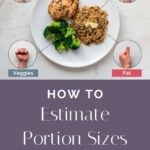
The hand method for portion sizes is a simple way to estimate portions without weighing or measuring food. By using your hand as a guide, you can quickly estimate the appropriate portion size of various foods, as follows:
- 1 portion of protein = 1 palm
- 1 portion of carbohydrates = 1 fist
- 1 portion of vegetables = 1 fist
- 1 portion of fruit = 1 fist
- 1 portion of fat = 1 thumb
The hand portion size method is simple yet effective as hand size is relative to the individual; bigger people tend to have bigger hands and tend to need more food, while smaller people tend to have smaller hands and tend to need less food. Hands are also portable and never change in size, which helps with consistency.
While many factors influence our exact calorie needs, and individual needs will vary, the hand portion size method is a great starting point that can be used to make outcome-based decisions and adjustments to support your personal health goals.
It’s important to note that portion sizes are not the same as serving sizes. A serving size is a standard measure of food that is used to quantify nutrition data for comparative purposes on food labels, while a portion size is how much food you choose to eat at a given time, based on your hunger cues and health goals, which may be more or less than a serving size.
Visual Examples of Hand Portion Sizes
Here are some visual examples of portion sizes using your hand for various food groups of minimally processed foods.

Meat, Fish, & Alternatives
Protein is an essential macronutrient for overall health and is particularly helpful for goals of weight loss, weight gain, and muscle building. Although exact protein needs vary by individual and their health goals, research shows that individuals looking to optimize their health should aim for 0.54 to 0.7 grams of protein per pound body weight per day. Fortunately, if you don’t want to weigh or measure your food, you can achieve this goal by consuming, at least, a palm-sized hand portion of plant or animal protein at every meal, such as chicken, beef, pork, salmon, eggs, tofu, and tempeh.

Whole Grains, Beans, Lentils, & Potatoes
Complex carbohydrates are an important part of a balanced meal, as they are sources of energy, fiber, and micronutrients. Opting for minimally processed versions of complex carbohydrates, such as rolled oats, rice, chickpeas, black beans, lentils, potatoes, and whole-grain pasta, can help to balance blood sugar and create more filling meals. Complex starchy carbohydrate portion size can be estimated by a fist-sized hand portion.

Fruits & Vegetables
Fruits and vegetables, be they fresh or frozen, are good sources of fiber and micronutrients. Due to their high fiber and water content, fruits and veggies are considered high-volume foods, as you can consume a large portion for a few calories. The current dietary guidelines recommend 14 grams of fiber per 1,00 calories, which works out to roughly 25 grams of fiber for an adult female and 38 grams of fiber for an adult male (1). The portion size of fruits and veggies can be estimated by a fist-sized hand portion, however, certain high-volume vegetables, such as leafy greens or zucchini, can be double or triple this size.

Milk & Yogurt
Dairy products such as milk, yogurt, Greek yogurt, skyr, and kefir naturally contain protein, carbohydrates, and healthy fats. For this reason, it can be difficult to determine how to use the hand portion size method to determine how to eat. While some of these products, such as Greek yogurt and skyr, are primarily protein sources, they also contain water, making them slightly higher-volume foods. Therefore, the portion size of milk and yogurt products can be estimated by a palm-sized hand portion.

Nuts & Seeds
While nuts and seeds contain protein, they are primarily sources of dietary fat and, therefore, portion size is measured as such. The portion size for nuts and seeds can be estimated by a thumb-sized hand portion, this also applies to nut and seed butters such as peanut butter, almond butter, and tahini.

Cheese
While cheese is a dairy product that contains protein, it’s primarily a source of dietary fat and is therefore portioned as such. Even the highest protein cheeses, like parmesan, Romano, and Gruyere, are considered moderate-volume foods due to their high fat content. The portion size of cheese can be estimated by a thumb-sized hand portion.

Oil & Butter
Fat is the most calorie-dense macronutrient, containing 9 calories per gram, compared to 4 calories per gram for protein and carbohydrates. Dietary fats such as olive oil and butter are considered low-volume foods as they contain little to no water or fiber and, therefore, have the smallest recommended portion size. The portion size of oil and butter can be estimated by a thumb-sized hand portion.
How to Build a Balanced Meal with Hand Portion Sizes
Using the hand portion size method as a guide, you can easily learn how to build a balanced meal by incorporating a portion of protein, carbohydrate, fiber, and fat into every meal. Whether you are eating breakfast, lunch, or dinner, add a portion of each component to your plate, bowl, or cup to ensure you are creating a well-balanced meal.

For example, a balanced meal might include a 1 palm-sized portion of chicken, a fist-sized portion of rice, a fist-sized portion of broccoli, and a thumb-sized portion of butter.

The Bottom Line
The hand portion size method is a great way to estimate portion sizes without measuring cups or food scales. Your hand is an effective tool to measure portion sizes as it is relative to you, doesn’t change in size, and is always with you. A portion of protein is the size of your palm, a portion of carbohydrate is the size of your fist, a portion of fruit and vegetables is the size of your fist, and a portion of fat is the size of your thumb.



Leave a Review