

Whether your goal is weight loss, muscle gain, or athletic performance, here are some simple tips for tracking macros so you can ensure you’re hitting your macro ratios with ease.

Table of contents
- Easy Tips for Counting Macros
- 1. Know your macro foods.
- 2. Use a reliable tracking app.
- 3. Plan your meals ahead of time.
- 4. Use a kitchen scale.
- 5. Save your meals.
- 6. Start with protein.
- 7. Don’t forget oils and fats.
- 8. Leave room for treats.
- 9. Aim for accuracy, not precision.
- Bonus Tip – Don’t forget your micros!
Tracking (or counting) macros (short for macronutrients) is a dietary strategy where you track the exact number of grams of carbohydrates, proteins, and fats you consume each day, rather than simply counting calories.
Macronutrients are the foundational building blocks of your diet, providing both essential health benefits and the energy your body needs to thrive. They make up the caloric content of the food you eat. Carbohydrates and proteins provide 4 calories per gram, while fats contain 9 calories per gram.
According to the Food and Nutrition Board of the Institutes of Medicine (IOM), the recommended macronutrient intake for healthy adults based on your total daily energy expenditure (TDEE) ranges as follows (1):
- Carbohydrate: 45–65% of total daily calories
- Fat: 20–35% of total daily calories
- Protein: 10–35% of total daily calories
The optimal macronutrient ratio will vary by individual based on their specific health goals, daily activity level, individual metabolism, and personal preference. For instance, a goal of weight loss or fat loss often favors higher protein intake (25–35%) to preserve muscle mass, while muscle gain or athletic performance may require higher carbohydrate intake (40–50%) to fuel intense training.
Regardless of goal, effectively tracking macros requires a personalized target calculation, a reliable measurement tool, and a simple way to log your food.
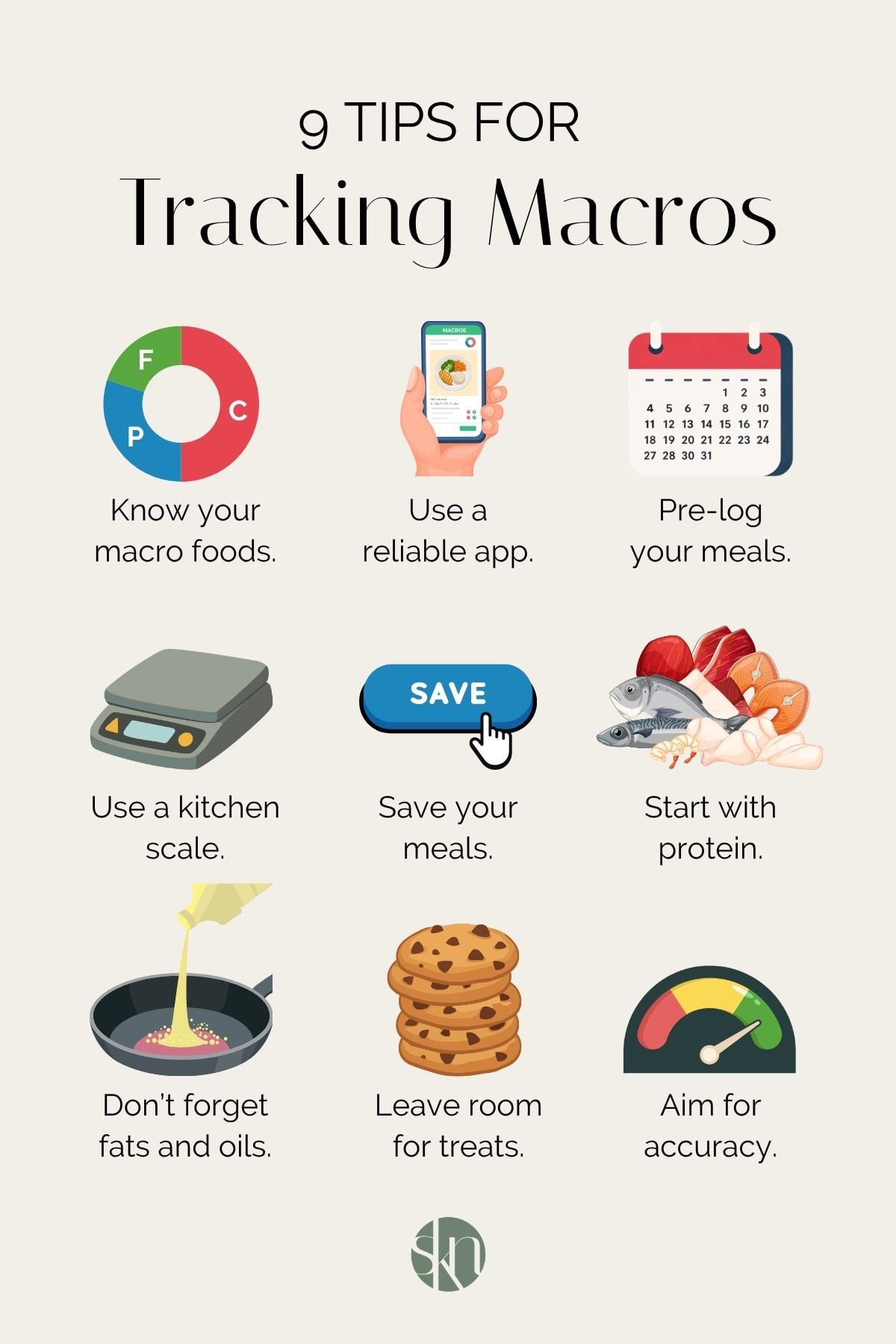
Easy Tips for Counting Macros
Here are some simple tips for counting macros.
1. Know your macro foods.
The better you understand macronutrients and their food sources, the easier tracking macros will be. Having a clear vision of what foods contain protein, carbohydrates, and fat, and in what combinations and ratios, can help to ensure you hit your macro targets with ease. For example:
- Need protein? Opt for chicken breast, pork tenderloin, canned tuna, or egg whites.
- Need carbs? Opt for white rice, potatoes, bread, or fruit.
- Need fat? Opt for olive oil, butter, coconut milk, or mayonnaise.
- Need carbs and protein? Opt for non-fat yogurt, beans, lentils, or peas.
- Need carbs and fat? Opt for chia seeds, dried coconut, sweet potato fries, or buttered popcorn.
- Need fat and protein? Opt for red meat, hummus, cheese, peanut butter, or bacon.
Understanding food macros bridges the gap between numbers on a screen and the food on your plate. The ultimate goal isn’t to weigh your food forever; rather, it’s a tool to learn the nutritional profile of what you eat, helping you build lasting food literacy
2. Use a reliable tracking app.
A reliable tracking app can streamline the process of logging meals and enhance accuracy in macro counting. Apps that source or verify nutrition data via authoritative bodies like the USDA, rather than relying solely on unverified user-generated entries, and barcode scanners for nutritional labels can reduce tracking errors and help save time.
Moreover, nutritional databases typically list the nutritional values of raw foods unless specified otherwise, so it’s important to be mindful of whether you are tracking in raw or cooked weights.
Some of the best and most reliable macro apps include MacrosFirst, MyFitnessPal, and MyMacros+. Other apps, such as Carbon and MacroFactor, offer algorithms that intuitively adjust your calorie and macro targets weekly based on progress rather than keeping static targets, which can lead to weight loss plateaus.
3. Plan your meals ahead of time.
Instead of waiting until the end of the day to log your meals – and find out what you’re missing – log your food in the morning or the night before. Pre-logging your meals doesn’t just help you hit your macros and avoid a stressful game of ‘Macro Tetris’ at night. It completely shifts your mindset, moving you away from reacting to what you eat and toward actively planning your nutrition.
4. Use a kitchen scale.
Accurate macro tracking requires weighing food precisely, and the more reliable your macros are, the quicker you will progress towards your goals. Using a digital food scale is the best way to track macros, as it provides far greater accuracy compared to volume measurements (i.e., cups, tablespoons, handfuls, etc.).
Measuring in grams on a kitchen scale also makes it easier to match packaged foods and tracking databases, as serving sizes are listed in grams. The tare (zero) function also lets you place a single bowl on the scale, zero it out, add an ingredient, and re-zero for the next item, avoiding a pile of dirty measuring cups.
5. Save your meals.
If you regularly eat the same breakfast, lunch, or dinner, save the meal in your tracking app so you can easily re-add it the next day. Eating repetitive meals is incredibly common when tracking macros, and can help to increase adherence, so saving meals allows you to log an entire recipe with a single tap rather than adding 5 to 10 individual ingredients every single day.
6. Start with protein.
Of all the macro targets, protein is the most commonly missed, and by a wide margin. By building a balanced meal around a source of protein, you can help to ensure you’re hitting your protein intake and avoid playing catch-up at the end of the day.
Focusing on protein, along with high-volume foods, is particularly helpful if you are trying to eat fewer calories to support a calorie deficit, as it can help to improve satiety and control hunger cues.
7. Don’t forget oils and fats.
Be sure to track oils and high-fat condiments (even healthy fats!), as they can significantly affect daily totals of fat intake. While a little drizzle of olive oil in a pan, a dollop of sour cream on potato, or a knob of butter on veggies may not seem like a big deal, dietary fats are the most calorie-dense foods, so it’s important to track every bite you consume.
8. Leave room for treats.
When tracking macros, it’s important that you leave room for your favorite foods. A good nutrition plan allows for flexible dieting, and leaving room for discretionary calories is essential to long-term diet success and sustainability.
So, whether your goal is to lose weight, gain muscle, or improve body composition, be sure to save 10-20% of your weekly calorie intake for your favorite latte, baked good, dessert, and/or glass of wine on a night out with friends.
9. Aim for accuracy, not precision.
When tracking macros, consistency matters more than daily perfection. Instead of stressing over exact numbers, aim for a close range of your daily macro targets: ±5 grams for protein and carbs, and ±2 to 3 grams for fats.
Allowing for flexibility in meeting macro targets can reduce tracking stress and support long-term consistency by accommodating real-life unpredictability. Remember, consistency is the foundation of the nutrition pyramid of priorities.
Bonus Tip – Don’t forget your micros!
When tracking macros, it’s important to not forget about micronutrients (vitamins and minerals). While macronutrients provide energy and building blocks, micronutrients run the chemical reactions that keep your organs, immune system, and brain working.
By focusing on whole foods over processed foods, and consuming a wide variety of colorful high-fiber foods, you can help to ensure you’re reaching your body composition and performance goals, while supporting your overall health and well-being.

The Bottom Line
Tracking macronutrients (proteins, carbohydrates, and fats) helps you target specific body composition and performance goals rather than just managing calorie quantity. By using a reliable app and kitchen scale, pre-logging meals, focusing on protein, allowing room for treats, and aiming for consistency, not perfection, you can better reach your goals.




Leave a Review