

While similar in look, cottage and ricotta cheese vary in texture, flavor, protein content, and overall nutrition. So, which one is healthier? Here is a full breakdown of cottage cheese vs ricotta cheese.
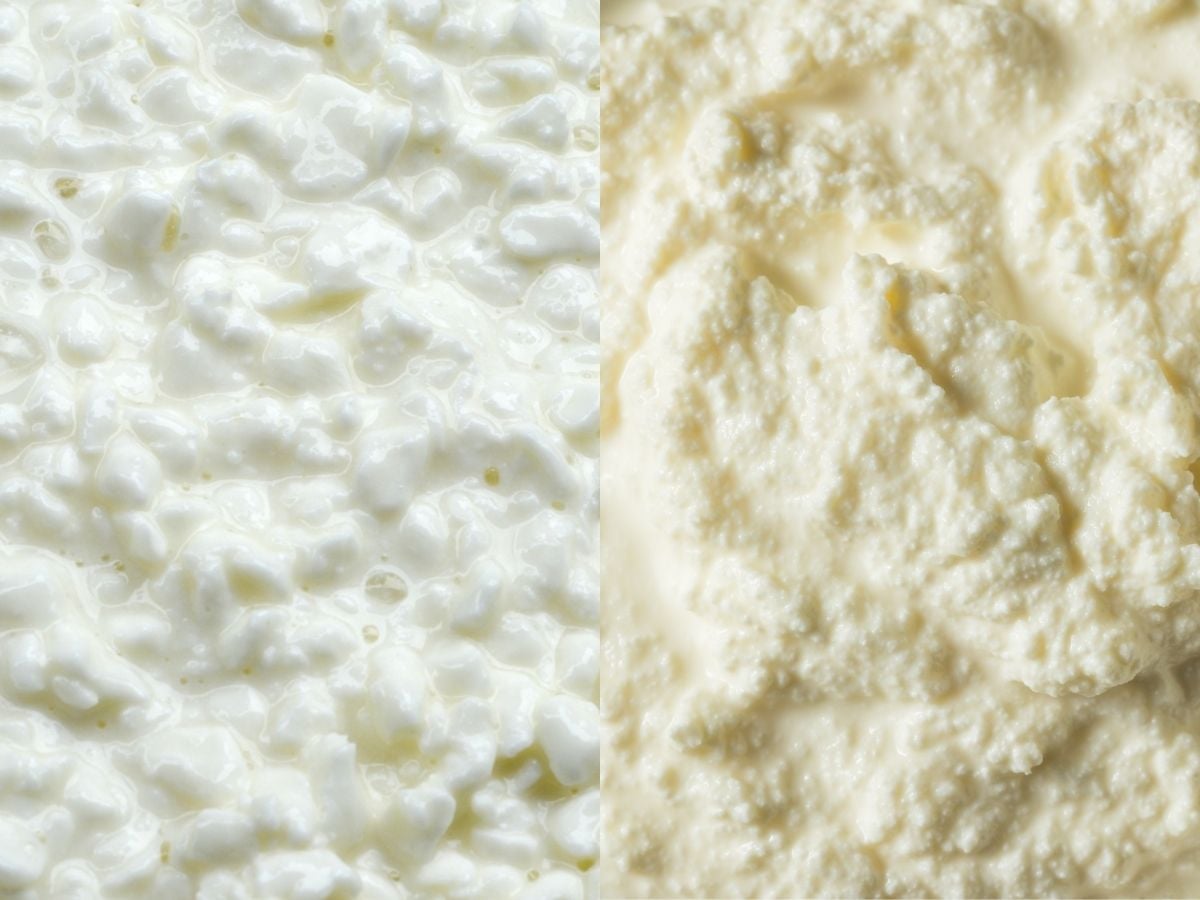
Table of contents
What’s the difference between cottage cheese and ricotta cheese?
Cottage cheese is made by adding acid or bacterial culture to cow’s milk, typically skim, and sometimes rennet, to create a thick, gelatinous mass (1). Once set, it is then cut into smaller pieces, known as curds, to create cottage cheese’s iconic “pebbled” texture. The curds are cooked to create a firmer texture and separate the liquid whey, and then drained, washed, and mixed with cream, salt, and sometimes stabilizers to create the final cottage cheese product.
Cottage cheese has a creamy yet lumpy texture and a salty, slightly tangy taste. It is commonly available in 4%, 2%, and 1% milk fat forms, and can be used in both sweet and savory dishes; however, it is best used in savory dishes, dips, as a substitute for sour cream or mayo in recipes, or eaten on its own in a breakfast bowl or as a high-protein snack.
Ricotta, which means “recooked” in Italian, is made from the liquid whey left over from the production of other cheeses(2). By heating this whey with acid, the remaining proteins clump into fine curds. These curds are then strained to remove excess liquid, leaving behind a soft, creamy cheese.
Ricotta cheese has a soft, yet slightly grainy texture, and a milky, slightly sweet taste. It is commonly found in full-fat (10%) and low-fat (5%) varieties, and can be used in sweet and savory dishes such as lasagna, ravioli, cannoli, pancakes, other baked goods, or as a toast topping.
| Feature | Cottage Cheese | Ricotta Cheese |
| Texture | Creamy, lumpy | Soft, slightly grainy |
| Flavor | Salty, slightly tangy | Milky, slightly sweet |
| Ingredients | Skim milk, bacteria, cream, salt, and stabilizers | Whey, milk, acid, salt, and stabilizers |
| Uses | Primarily savory, some sweet recipes | Sweet and savory recipes |
| Types | 4%, 2%, and 1% | Full-fat and low-fat |
Cottage Cheese vs. Ricotta Cheese: Nutrition
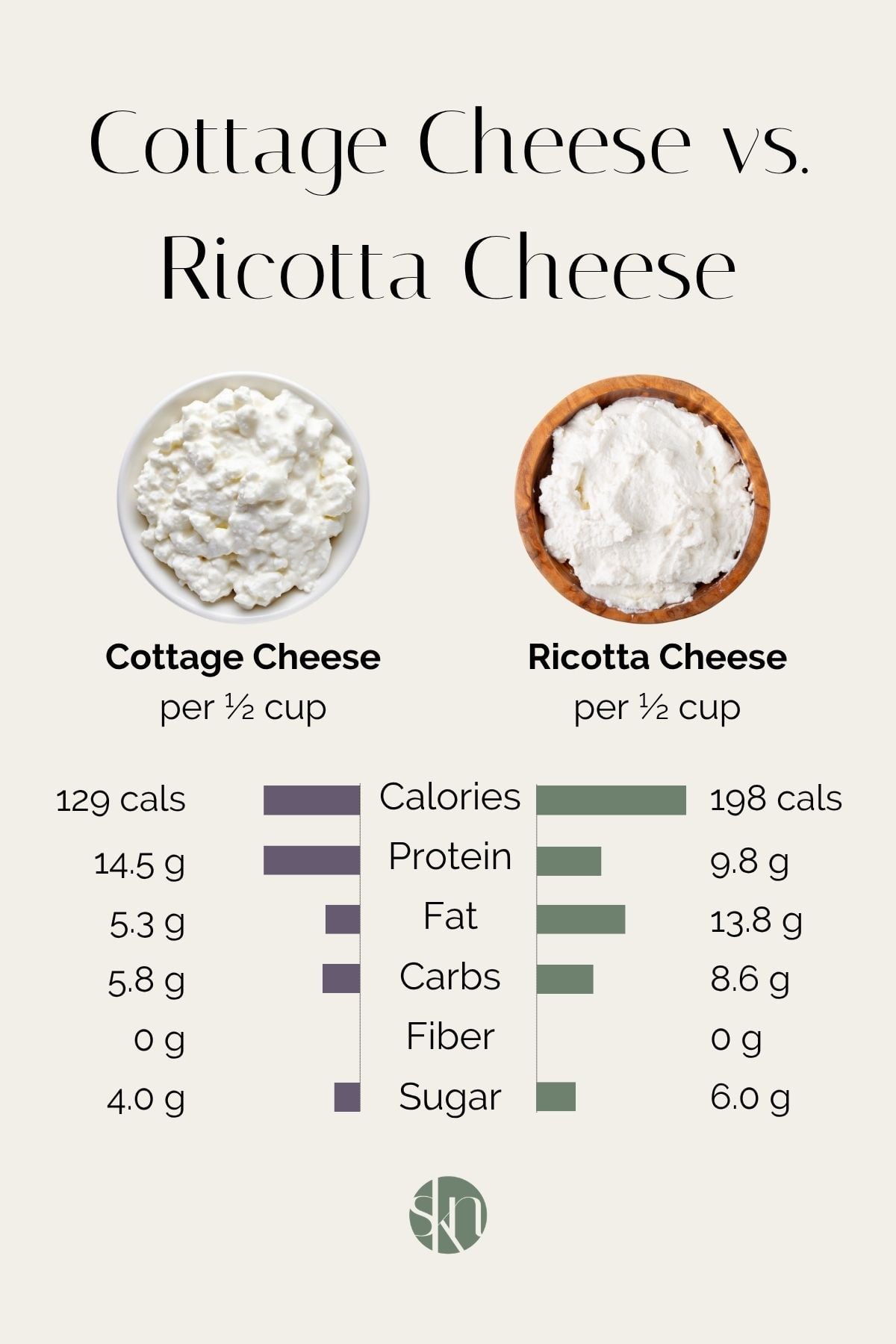
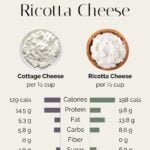
Here is a nutrition comparison of the calorie and macronutrient content of a 1/2-cup (125-gram) serving of full-milk cottage cheese and whole-milk ricotta cheese (3, 4).
| Nutrition per 1/2 cup | Cottage Cheese | Ricotta Cheese |
| Calories | 129 calories | 198 calories |
| Protein | 14.5 grams | 9.8 grams |
| Fat | 5.3 grams | 13.8 grams |
| Carbohydrate | 5.8 grams | 8.6 grams |
| Fiber | 0.0 grams | 0.0 grams |
| Sugar | 4.0 grams | 6.0 grams |
Calories
Ricotta cheese has more calories than cottage cheese. This is due to the higher fat content in ricotta cheese, which is the most calorie-dense macronutrient. A 1/2-cup serving of cottage cheese contains 129 calories, while a 1/2-cup serving of ricotta cheese contains 198 calories.
Protein
Cottage cheese contains more protein than ricotta cheese. This is because cottage cheese is made from milk curds, which have a higher protein concentration than the liquid whey used to make ricotta. A 1/2-cup serving of cottage cheese contains 14.50 grams of protein, while a 1/2-cup serving of ricotta cheese contains 9.76 grams of protein.
Fat
Ricotta cheese contains more fat than cottage cheese. The difference in fat content is due to the fact that cottage cheese is made from skim milk with added cream, while ricotta cheese is made from leftover whey, which has a higher fat content. A 1/2-cup serving of cottage cheese contains 5.28 grams of fat, while a 1/2-cup serving of ricotta cheese contains 13.75 grams of fat.
Carbohydrates
Ricotta cheese contains slightly more carbohydrate than cottage cheese; however, neither is a significant source. A 1/2-cup serving of cottage cheese contains 5.75 grams of carbohydrate, while a 1/2-cup serving of ricotta cheese contains 8.58 grams of carbohydrate.
Sugar
Cottage cheese contains slightly less sugar than ricotta cheese. This is because the liquid whey used to make ricotta has a higher concentration of natural sugars. A 1/2-cup serving of cottage cheese contains 4.00 grams of sugar, while a 1/2-cup serving of ricotta cheese contains 6.00 grams of sugar.
Fiber
Neither ricotta nor cottage cheese is a source of fiber.
Vitamins & Minerals
Given that cottage and ricotta cheese are both dairy products, they contain similar micronutrients; however, their profiles vary slightly due to their production. Ricotta cheese contains more calcium, phosphorus, riboflavin, vitamin A, and vitamin B12, while cottage cheese contains more folate and sodium.
| Nutrition per 1/2 cup serving | Cottage Cheese | Ricotta Cheese |
| Vitamin A | 45 µg | 159 µg |
| Riboflavin (Vitamin B2) | 0.23 mg | 0.41 mg |
| Folate (Vitamin B9) | 0.87 µg | 0.50 µg |
| Vitamin B12 | 0.83 µg | 0.98 µg |
| Calcium | 110 mg | 280 mg |
| Sodium | 438 mg | 131 mg |
| Phosphate | 193 mg | 203 mg |
That said, the exact macronutrient and micronutrient profile of cottage and ricotta cheese will vary by milk fat percentage and brand.
So, is cottage cheese or ricotta cheese healthier?
Both ricotta and cottage cheese are fresh cheeses and minimally processed foods that provide numerous health benefits. While cottage cheese is generally considered “healthier” due to its lower calorie, higher protein, lower fat, and lower carb content per serving, it has no inherent health benefits over ricotta cheese.
In fact, no individual cheese, food, or dairy product can cause weight gain, weight loss, or impede health, aside from food allergies. Both ricotta and cottage cheese can be included in a healthy diet, whether you are eating healthy or dieting.
Moreover, the exact nutritional profile of cottage cheese and ricotta cheese will vary based on brand and milk fat percentage (i.e., 4% vs 1%), and various options can be used to support your goals, whether you are counting calories or macros, or just trying to eat a little healthier.
Ways to Use Cottage Cheese and Ricotta Cheese
Here are some examples of how you can use cottage and ricotta cheese:
- Top cottage cheese with homemade granola and fresh berries for breakfast.
- Blend ricotta cheese into smoothies for added protein and a creamy texture.
- Add cottage cheese to pancakes for a protein boost.
- Mix ricotta cheese with pumpkin purée for a creamy pumpkin pasta sauce.
- Blend cottage cheese with tomatoes for a high-protein pasta sauce.
- Use ricotta cheese to add protein to a vegetable lasagna.
- Top cottage cheese with boiled eggs for a savory breakfast bowl.
- Spread ricotta cheese onto bread for a high-protein toast topping.
FAQs
The size of the curds in cottage cheese varies due to the production process. Small curd cottage cheese is made by making smaller cuts and heating them to a higher temperature, while large curd cottage cheese is made by making smaller cuts and heating them to a slightly lower temperature.
They can generally be interchanged in savory recipes, such as lasagna, stuffed shells, and pasta bakes; however, they cannot always be substituted in sweet recipes, such as canolis or cheesecake. When substituting cottage cheese for ricotta, it’s best to blend the cottage cheese before using it in the recipe to replicate the smoother texture of ricotta.
The “healthiest” cheese depends on your health goals and personal preference. That said, healthy cheeses are generally considered minimally processed, high in protein, and low in sodium. Parmesan, Romano, and Gruyère are the highest-protein cheeses.

The Bottom Line
Both cottage cheese and ricotta cheese are minimally processed foods that can be included in a healthy diet. While cottage cheese is lower in calories, higher in protein, and lower in fat, ricotta cheese is richer in vitamins and minerals. That said, cottage and ricotta come in varying fat percentages from different brands, so their exact nutritional profile can vary.


I really enjoy your educational series on nutrition! Often these topics aren’t general knowledge and I appreciate the information.
Thanks, Christine! I’m so happy you enjoy the information, lots more to come. 🙂