

Whether your goal is to lose weight or maintain weight loss, monitoring the number of calories you consume is essential for success. Here are the best and easiest tips for cutting calories to help you achieve your goals.
Table of contents
Weight loss is a balancing act that requires you to consume fewer calories than you expend, creating a calorie deficit. While many people only focus on one side of this equation (i.e., eat less OR exercise more), both diet and exercise are required for successful and sustained weight loss.
Although exactly how many calories you need to cut per day for weight loss will vary by age, sex, height, weight, and activity level, on average, a deficit of 10% to 30% of Total Daily Energy Expenditure (TDEE) is required for healthy fat loss. For most healthy adults, this equates to a 200-500 calorie deficit per day, which can lead to 0.5 to 1 pound of weight loss per week.
Fortunately, there are many simple strategies you can implement into your daily eating habits that will support your weight loss goals without feeling deprived or starving.
Simple Tips to Cut Calories
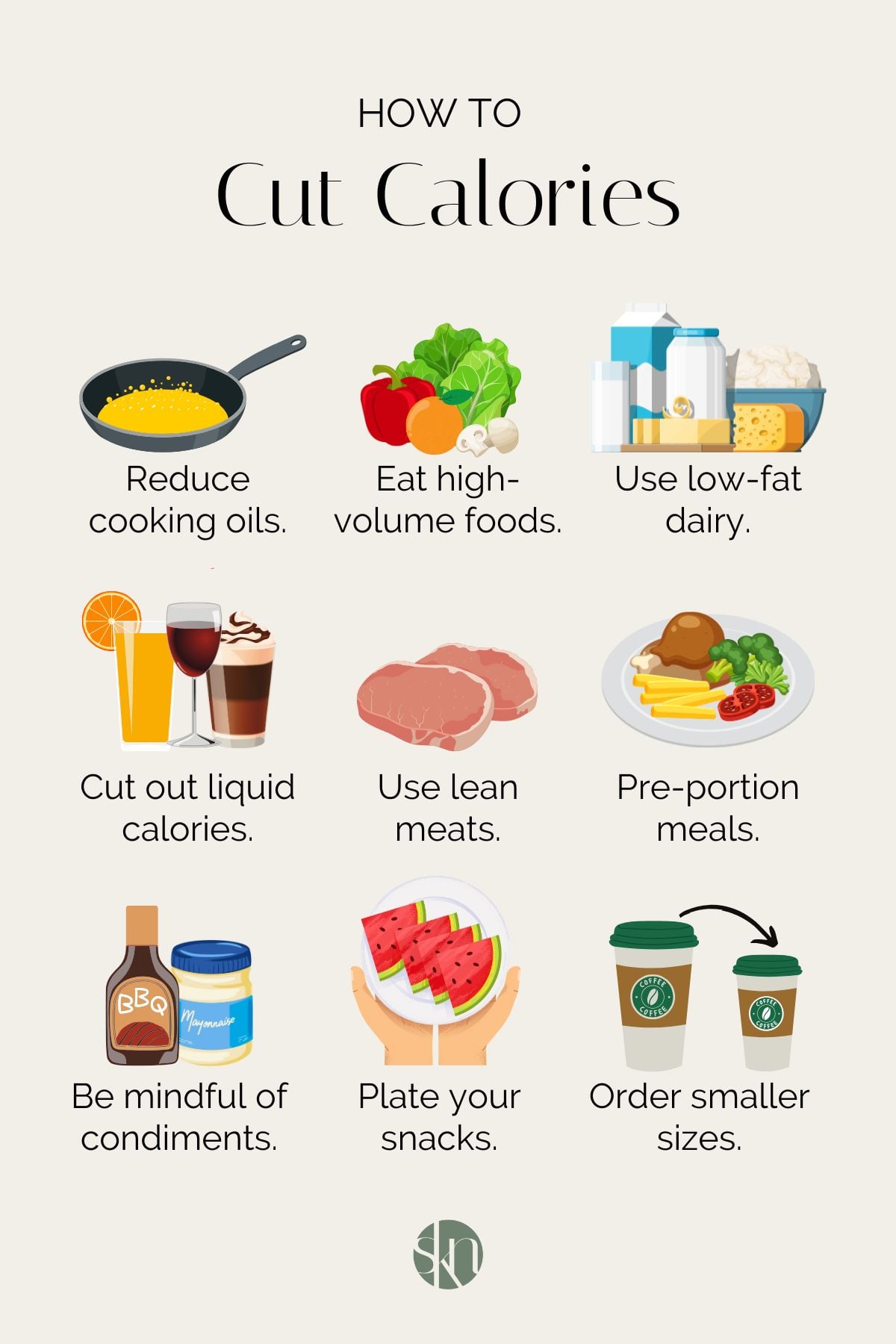
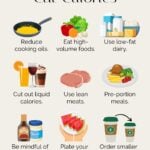
Here are 9 tips to help you eat fewer calories with minimal effort.
1. Reduce cooking oils.
Reducing the amount of cooking oil you use is a very simple way to cut calories. Although cooking oils should be included in a balanced diet, particularly heart-healthy cooking oils like olive oil and avocado oil, oils are solely a source of fat and one of the most calorie-dense foods.
Fats provide 9 calories per gram, while carbohydrates and protein provide 4 calories per gram, and therefore contribute to calorie intake much quicker than other macronutrients. For instance, a one-tablespoon serving of olive oil contains 119 calories; however, the typical “pour” of olive oil into a pan often contains 2-3 tablespoons, which can quickly add 200-300 calories to a meal in a matter of seconds (1).
By measuring or limiting the amount of cooking oil used, you can easily cut calories and avoid this oh-so-common calorie-counting mistake. Moreover, by opting for lower-fat cooking methods such as steaming, baking, or grilling instead of frying or deep-frying, you can further reduce your calorie intake.
2. Eat high-volume foods.
Volume eating is a great strategy for weight loss. High-volume foods are high in fiber, water, and/or air, and, therefore, low in calories. These foods allow you to eat large portions of food and help to increase feelings of fullness without overly increasing calorie intake.
Common examples of high-volume foods include leafy green vegetables, broccoli, cabbage, cauliflower, peppers, zucchini, cucumber, celery, citrus fruit, and berries. Many of the foods also happen to be high-fiber foods and very filling foods, which can help to increase feelings of satiety and further reduce calorie intake.
3. Use low-fat dairy products.
While dairy products are a good source of healthy fats, opting for low-fat versions of them is another easy way to cut calories. Low-fat dairy products are lower-calorie options, but still retain their micronutrient and protein content, particularly in the case of milk, yogurt, and cheese.
For instance, reduced-fat milk (2%) and low-fat milk (1%) contain fewer calories than whole-fat milk (3.25%), but contain the same amount of protein at 8 grams per 1-cup serving (2, 3, 4). Additionally, a 3/4-cup serving of plain low-fat yogurt contains 50 fewer calories than plain whole milk yogurt, but slightly more protein (5, 6).
4. Cut out liquid calories.
One of the simplest ways to cut calories from your diet is to avoid, or at least limit, beverages that contain calories. By only drinking calorie-free beverages, such as water, sparkling water, herbal tea, and black coffee, you can keep your calorie intake down and avoid added sugars at the same time.
While beverages such as fruit juices and fruit smoothies can certainly be included in a healthy diet, they are often consumed along with meals, which can easily add extra and unnecessary 100-500 calories. If unaccounted for, even healthy liquid calories can make creating a calorie deficit or maintaining a healthy weight difficult. Therefore, it’s best to limit liquid calories, be it alcohol, soda, or juices, when looking to cut calorie intake.
5. Use lean meats.
Swapping fatty cuts of meat for lean cuts is another easy way to cut calories. Not only are lean meats lower in saturated fat, and therefore lower in calories, but they are also higher in protein than the richer cuts, and most of the best high-protein, low-calorie foods.
Lean meats include skinless chicken breasts and turkey breasts, ground chicken or ground turkey, lean cuts of beef such as lean ground beef, sirloin, round, and flank steak, lean cuts of pork such as loin and tenderloin, seafood such as tuna, cod, and fish, as well as venison and bison. Opting for these cuts can keep your protein intake high, but cut calories thanks to the reduced fat content.
6. Pre-portion meals.
Instead of serving food “family style”, where dishes are placed on the table, portion food onto your plate before sitting at the table. Although eating family style is fun and perfectly fine to do some time to time, it encourages mindless eating and second helpings, which can increase calorie intake.
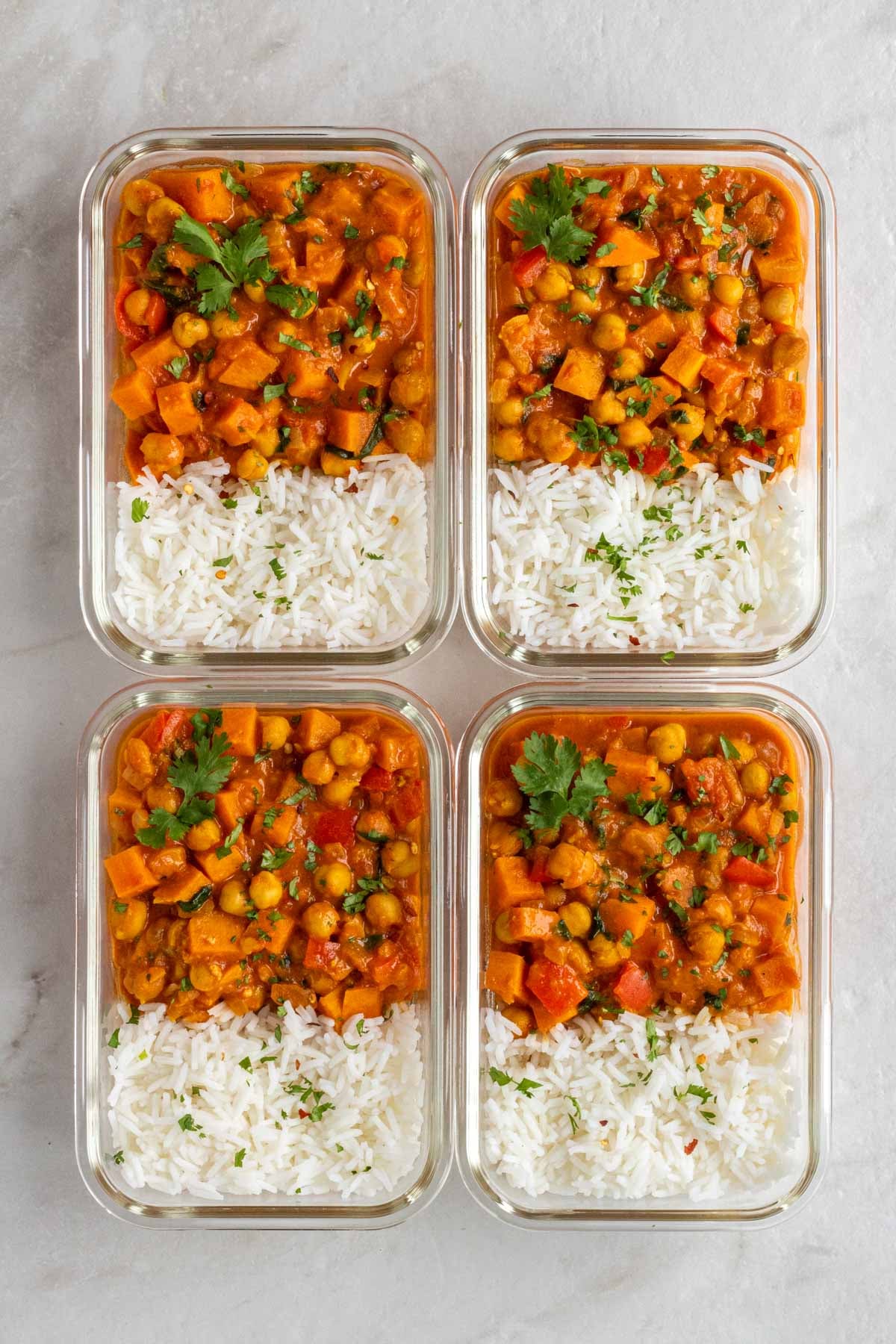
By serving food “plate style”, you can implement better portion control and create balanced meals at the same time. This strategy is also helpful for meal prep, as you can cook a large batch of food and pre-portion it into individual containers for grab-and-go, calorie-controlled meals.
7. Be mindful of condiments.
Sauces, dressings, and dips can provide additional flavor to healthy meals, but many are very high in calories and should be consumed in moderation if trying to cut calories. High-fat condiments, such as mayonnaise, sour cream, and ranch dressing, are very rich, and a mere 2-3 tablespoons can add 200-300 calories to a meal (7, 8, 9).
While you don’t need to avoid condiments completely, being mindful of portion size and using low-fat, low-calorie condiments such as mustard, hot sauce, and salsa, you can help to cut calorie content without forgoing flavor.
8. Plate your snacks.
Serving snacks on an individual serving plate or bowl can help to cut calories as opposed to eating them directly from their original packaging. Research has shown that people tend to eat more calories out of large packages, especially when it comes to snacks. In some cases, the lack of a visual portion size led to a 129% increase in calories consumed (10, 11).
Moreover, snacks are one of the largest contributors to added sugars and calories in the standard American diet, contributing to approximately 20% of energy intake (12). Many of the popular snacks are also ultra-processed foods, often referred to as empty calories, which have a high calorie density and low nutrient density.
While there is certainly room for unhealthy snacks or discretionary calories, by opting for whole food snacks, such as fresh fruit and vegetables, nuts or seeds, or minimally processed snacks, such as air-popped popcorn and cheese, you can further cut calorie intake and increase vitamin and mineral intake at the same time.
9. Order smaller sizes.
When dining out, simply ordering a smaller portion size can significantly reduce calorie intake. This simple strategy can allow you to enjoy a coffee break with a co-worker or a meal out with friends while saving you hundreds, if not thousands, of calories.
Additionally, pairing this strategy with other calorie-cutting tips can further reduce the calories consumed. For instance, ordering a small non-fat latte as opposed to a large whole-milk latte can help you cut 145 calories, while ordering a small serving of French fries and a chicken burger instead of a large serving of French fries and a double cheeseburger can help you cut 370 calories in a single meal (13, 14, 15, 16).

The Bottom Line
Finding ways to reduce calorie intake is essential for weight loss. Simple tips for cutting calories include reducing cooking oil, eating high-volume foods, using low-fat dairy products, cutting liquid calories, using lean meats, pre-portioning meals, being mindful of condiments, plating snacks, and ordering smaller portion sizes.

Leave a Review