

While weight loss is difficult, maintaining weight loss tends to be more challenging. Unfortunately, research has shown that despite exhaustive diets and weight loss efforts, most people regain the weight they lost. However, with the right approach and lifestyle changes, maintaining weight loss is possible.
Table of contents
- What is weight loss maintenance?
- 12 Strategies to Maintain Weight Loss
- 1. Pick a sustainable weight loss approach.
- 2. Follow a dietary pattern you enjoy.
- 3. Understand your maintenance calorie intake.
- 4. Eat breakfast regularly.
- 5. Prioritize protein and fiber.
- 6. Indulge in treats occasionally.
- 7. Prioritize resistance training.
- 8. Exercise regularly.
- 9. Practice mindful eating.
- 10. Learn to self-monitor.
- 11. Aim for consistency, not perfection.
- 12. Find a support system.
- FAQs
What is weight loss maintenance?
Weight loss maintenance is broadly defined as sustaining a lower body weight, often after a period of dieting for intentional weight loss. More specifically, a scientific review defined successful long-term weight loss maintenance as intentionally losing at least 10% of initial body weight and keeping it off for at least 1 year (1).
While this definition helps provide a framework for weight loss maintenance, in reality, maintenance is less of a specific set point weight and more of a “settling” point or body weight range. Fluctuations in body weight, within a 2-3% range, are natural, normal, and should not be a cause for concern.
For example, a 5’6″ adult female who began her weight loss journey at 200 pounds and reached a goal weight of 150 pounds could experience fluctuations in body weight between 146 and 155 pounds and would be considered to be maintaining weight loss.
Moreover, individuals who’ve lost weight may gain a bit of weight during holidays and vacations, but return to a lower body weight once they’re back to their regular day-to-day routine, while other indivudals may choose to get a bit leaner for summer and carry a bit of weight for warmth in winter, but generally remain within the same range of desirable body weight.
Unfortunately, only 20% of dieters are able to sustain weight loss, while the other 80% fail to maintain any body weight they’ve lost (2). However, according to the National Weight Control Registry (NWCR), the largest ongoing study of individuals who successfully maintain weight loss, weight loss maintainers share common behaviors and strategies that help them keep the weight off.
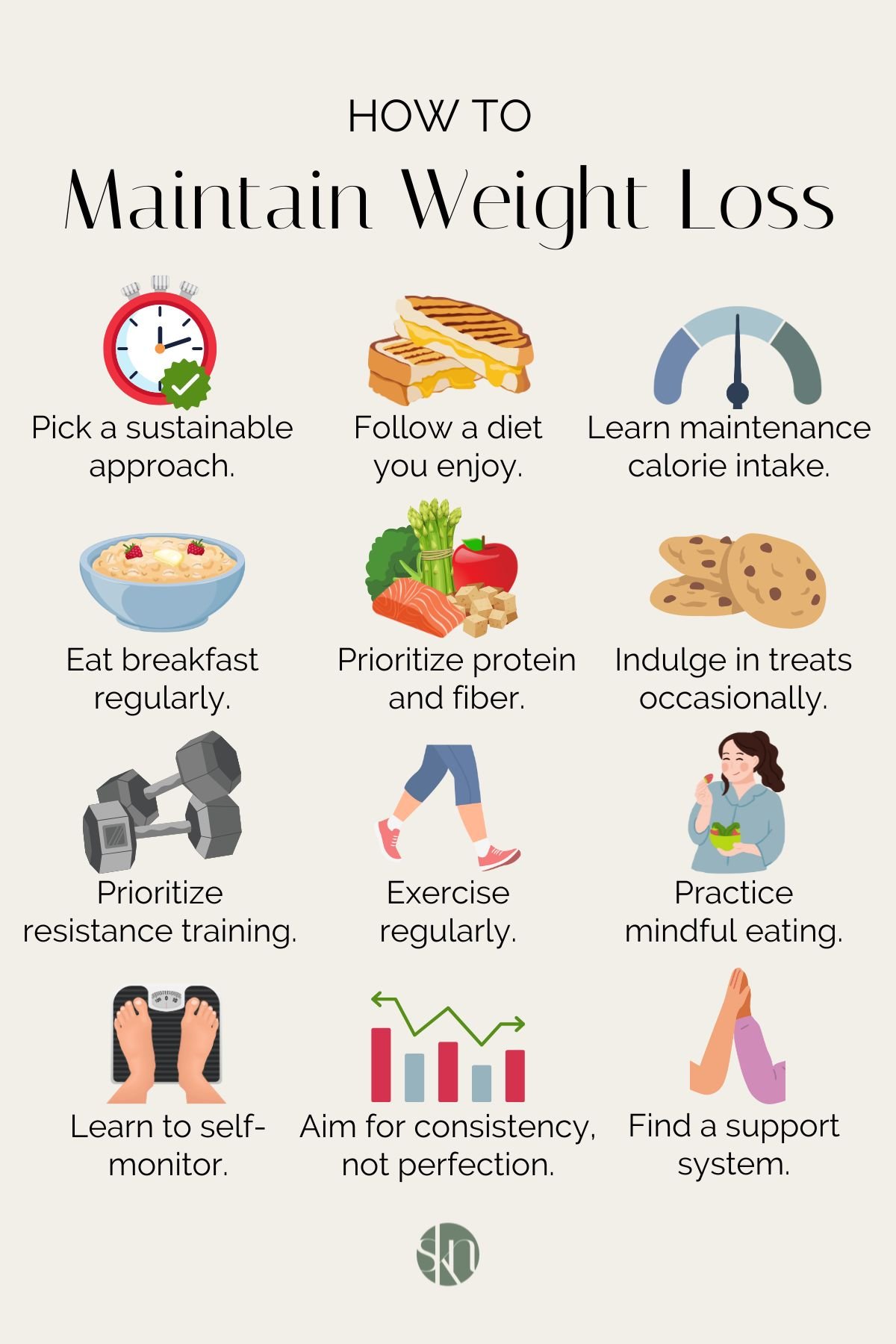
12 Strategies to Maintain Weight Loss
While there are many reasons people regain lost weight, here are common strategies that weight loss maintainers have been reported to practice.
1. Pick a sustainable weight loss approach.
An argument can be made that successful weight loss maintenance begins before any weight has been lost. While extreme calorie restriction and excessive exercise may help someone lose weight, they deprive the individual of the important lessons, diet, and lifestyle changes required for long-term weight loss.
Maintaining weight loss is a skill. Not only does it require a change in behaviors, but it often requires a shift in mindset and coping mechanisms. Instead of looking for the quickest path to weight loss, it’s important to focus on how you can overhaul your current behaviors for healthier alternatives that are sustainable. The most important determinants of weight loss maintenance are those that cement changes in behavior.
2. Follow a dietary pattern you enjoy.
The “best” diet for weight loss and weight maintenance is the one that you enjoy. Although weight loss maintainers generally follow a low-fat diet, research has clearly shown that all dietary patterns can support weight loss maintenance, assuming total calorie intake is controlled for (3).
While it’s important to prioritize healthy foods for overall health, whether an individual chooses to eat a conventional, vegetarian, plant-based, or low-carb diet will not hinder their ability to maintain weight loss. Rather, it is the ability to consistently make healthy food choices that will support successful weight maintenance, and a diet that you enjoy is more likely to be sustainable long term.
Furthermore, it’s important to distinguish between healthy eating and dieting for weight maintenance. Dieting involves calorie restriction to create a calorie deficit, when you’re consuming fewer calories than you’re expending, and is required for weight loss; however, it is not required for weight maintenance. Rather, weight maintenance can be accomplished by eating healthy with a lifestyle focused on overall well-being and balance.
3. Understand your maintenance calorie intake.
Maintenance calories are the number of calories you need to consume per day to maintain your current body weight. Maintenance calorie intake is the point where energy balance is even, or your energy intake from food and beverages meets your energy expenditure through metabolism and physical activity.
Women typically require between 1,600 and 2,400 calories per day for weight maintenance, while men require between 2,000 and 3,000 calories per day (4). The exact number of calories needed to maintain weight will vary based on the individual’s age, height, weight, metabolic rate, and activity level.
Understanding maintenance calorie intake can be beneficial, whether you are counting calories or not. If counting calories or reverse dieting, understanding your maintenance intake can help ensure your target calorie intake is accurate. If not counting calories or estimating portion sizes, understanding your maintenance intake can help put calorie content on food labels and restaurant meals into perspective to help you make choices that support your weight maintenance goal.
If counting calories or macros, you can increase your deficit intake to meet your maintenance needs, or reverse diet to determine your new maintenance to mitigate potential metabolic adaptation. If you’re not counting calories or macros, you can estimate your maintenance calorie intake by using an online Total Daily Energy Expenditure (TDEE) calculator.
4. Eat breakfast regularly.
According to the National Weight Control Registry, nearly 80% of individuals who can maintain weight loss report eating breakfast every day. While eating breakfast does not inherently cause weight maintenance, nor does skipping breakfast cause weight regain, breakfast eaters tend to have overall healthier eating habits and exercise more.
Regularly eating breakfast, particularly a balanced meal, can help improve energy levels, balance blood sugar, increase fullness, and ensure you’re properly fueled for the day. In turn, this can help mitigate hunger levels and cravings later in the day, which can help ensure you’re not consuming more calories than needed to maintain weight.
5. Prioritize protein and fiber.
Not only are protein and fiber beneficial for weight loss, but eating well-balanced meals with adequate protein and fiber can help to maintain weight loss. Protein, be it plant or animal protein, is considered the most satiating macronutrient, and high-protein and high-fiber foods are consistently ranked as the most filling foods.
Prioritizing protein and fiber in meals can help improve satiety, increase feelings of fullness, balance blood sugar, and, in turn, minimize hunger cues and cravings (5). This will help to control calorie intake and mitigate weight regain.
6. Indulge in treats occasionally.
Enjoying treats in moderation in an otherwise balanced diet is beneficial for long-term weight maintenance. While many believe they must eat “clean” or perfectly to lose or maintain body weight, it is possible to occasionally eat treats without derailing your goals. Be it desserts or alcohol, there is room for “empty calories” and low-nutrient-density foods when trying to sustain weight loss.
In fact, research has repeatedly shown that people who follow diets with greater flexibility have greater long-term success with flexible dieting (6, 7). This approach fosters a more positive relationship with food and mindful eating behaviors, which promotes more sustainable eating patterns.
This “all-foods-fit” approach emphasizes meeting calorie and macronutrient needs without restricting food choices. Meaning, you can enjoy discretionary calories; the “extra” calories in your diet after your daily needs for essential nutrients are met, while still supporting your weight goals. That said, discretionary calories should represent no more than 10-20% of calorie intake, while the other 80-90% of calorie intake should come from unprocessed and minimally processed foods (8).
7. Prioritize resistance training.
Resistance training, also known as strength training, helps maintain weight loss by building or maintaining muscle mass. Muscle helps to support our basal metabolic rate, which is the primary component of metabolism and directly impacts our total calories burned throughout the day. Our resting energy expenditure is largely dependent on our fat-free mass; therefore, the more muscle mass we build through resistance training, the higher our resting energy expenditure (9).
Research has shown that individuals who lift weights are more likely to maintain weight loss by maintaining muscle mass. Moreover, compared to cardio, resistance training is more effective in changing body composition, which can alter body shape and reduce inches, even if there is little weight loss reflected on the scale.
8. Exercise regularly.
In addition to resistance training, regular physical activity is highly beneficial for maintaining weight loss and a healthy body weight. The National Weight Control Registry research shows that 90% of weight loss maintainers exercise an average of 1 hour per day, and other studies have shown that those who do 200 minutes of exercise per week are more likely to maintain their weight (10, 11).
While a healthy diet has a greater impact on weight management, both diet and exercise are crucial. Regular exercise helps increase energy expenditure, which aids in weight maintenance by increasing how many calories are burned. This aids in creating energy balance while providing more dietary freedom at the same time.
9. Practice mindful eating.
One of the most challenging aspects of weight loss and weight maintenance is changing dietary behaviors, emotional responses, and coping mechanisms with food. Research has shown that the prevalence of emotional eating, (over)eating in response to negative emotions, is high among individuals who are overweight and obese, particularly women, compared to individuals with a normal BMI (12, 13, 14).
While the exact cause of emotional eating differs by individual, and should be treated accordingly by a qualified health professional, the practice of mindful eating can help to bring more awareness to our eating experience. It involves paying close attention to your food and eating experience by being aware, present, and non-judgmental, and is commonly used by registered dietitians to help curb emotional eating patterns along with healthy eating habits.
10. Learn to self-monitor.
Learning to monitor your behaviors is more likely to help prevent weight regain. Weight loss maintainers are more likely to track weight, diet, or exercise, and use calorie-counting apps.
Based on the evidence, frequent self-weighing, at least once per week, appears to be a good predictor of moderate weight loss, less weight regain, or the avoidance of initial weight gain in adults (15). Moreover, individuals who weigh themselves regularly tend to eat fewer calories compared to those who don’t, up to 300 calories per day in some cases, which is particularly helpful for maintaining energy balance (16, 17).
11. Aim for consistency, not perfection.
For long-term weight loss maintenance, it’s important to aim for consistency, not perfection. While weight loss requires more rigidity and diligence, weight maintenance is more fluid, and there is more room for indulgence.
Fluctuations and plateaus in weight are to be expected, and setbacks are normal. Whether it’s a missed workout, an indulgent restaurant meal, or a weekend away, a little time “off track” is nothing to worry about or a reason to give up on the process. Rather, the objective is to aim for long-term consistency in your food, exercise, and lifestyle choices.
12. Find a support system.
Much like a weight loss journey, finding a support system is incredibly helpful on a weight maintenance journey. Finding the continued motivation and strong sense of discipline to continue the healthy habits required to maintain weight loss can be difficult alone.
Having a friend, co-worker, or family member who shares similar goals and values can help to hold you accountable and inspire you to keep going. In fact, research has shown that having a buddy to pursue weight management goals significantly increases the likelihood of success (18, 19).
FAQs
Yes, by closely monitoring food choices, exercising regularly, self-monitoring weight, and finding a supporting system, it is possible to maintain weight loss.
Research shows that the most common diet and lifestyle strategies implemented by weight loss maintainers are eating a diet low in fat, eating breakfast regularly, frequent self-monitoring of body weight and food intake, and high levels of regular physical activity.

The Bottom Line
While weight loss maintenance can be difficult, it is possible and can be achieved with effective diet and lifestyle strategies. To prevent weight regain after a weight loss journey, focus on following a dietary pattern you enjoy while enjoying treats in moderation, eating breakfast regularly, prioritizing protein and fiber, exercising regularly, practicing mindful eating, self-monitoring weight and food intake, and finding a support system.


Leave a Review