

Almond flour is often suggested as a healthier alternative to regular flour, but is that true? Here is a nutrition breakdown and comparison of almond flour vs. all-purpose flour, so you can make the best choice for your diet and health goals.
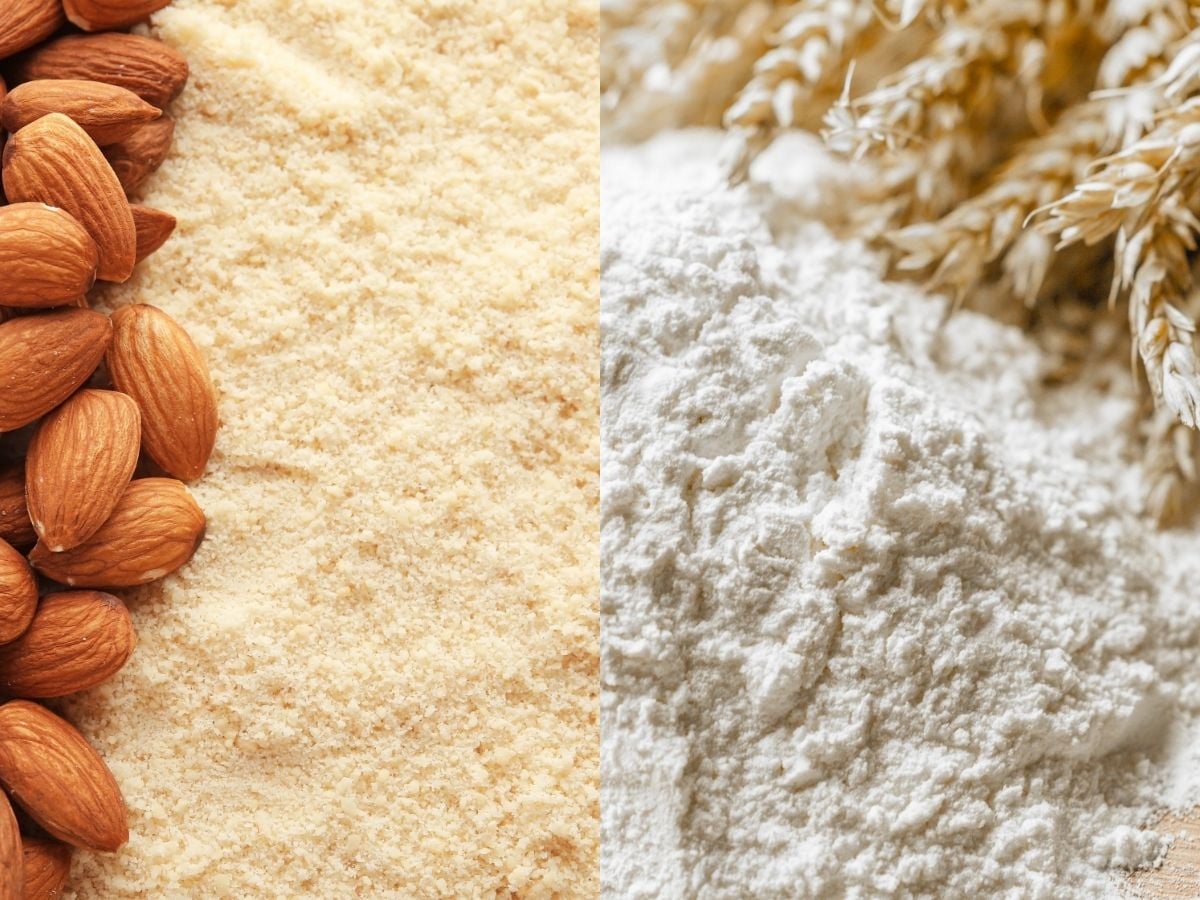
Table of contents
- What’s the difference between almond flour and all-purpose flour?
- Almond Flour vs. All-purpose Flour: Nutrition
- Calories
- Protein
- Fat
- Carbohydrates
- Fiber
- Sugar
- Vitamins and Minerals
- Other Factors to Consider
- Can you substitute almond flour for all-purpose flour in recipes?
- So, is almond flour healthier than all-purpose flour?
What’s the difference between almond flour and all-purpose flour?
Almond flour and all-purpose flour differ in their sources, production methods, nutrient profiles, and uses.
Almond flour is made from finely ground almonds. It is made by blanching whole, raw almonds in boiling water to remove their skin and then grinding them into a fine powder. Almond flour is naturally gluten-free and offers a subtle nutty flavor and tender, moist, but dense texture.
All-purpose flour is made from refined wheat kernels. Often referred to as “regular flour”, it is made by removing the bran and germ of wheat kernels to leave only the endosperm, and then grinding it into a fine powder. All-purpose flour is a highly versatile flour that can be used as a thickening agent or to create a soft, light, and fluffy texture in baked goods.
| Type of Flour | Almond Flour | All-Purpose Flour |
| Source | Almonds | Wheat |
| Production Method | Made by grinding blanched almonds into a fine powder | Made by grinding the endosperm of wheat kernels into a fine powder |
| Taste | Nutty, slightly sweet | Mild, neutral |
| Baking Texture | Tender, moist, and dense | Soft, light, and fluffy |
| Gluten Content | Gluten-free | Contains gluten |
Almond Flour vs. All-purpose Flour: Nutrition
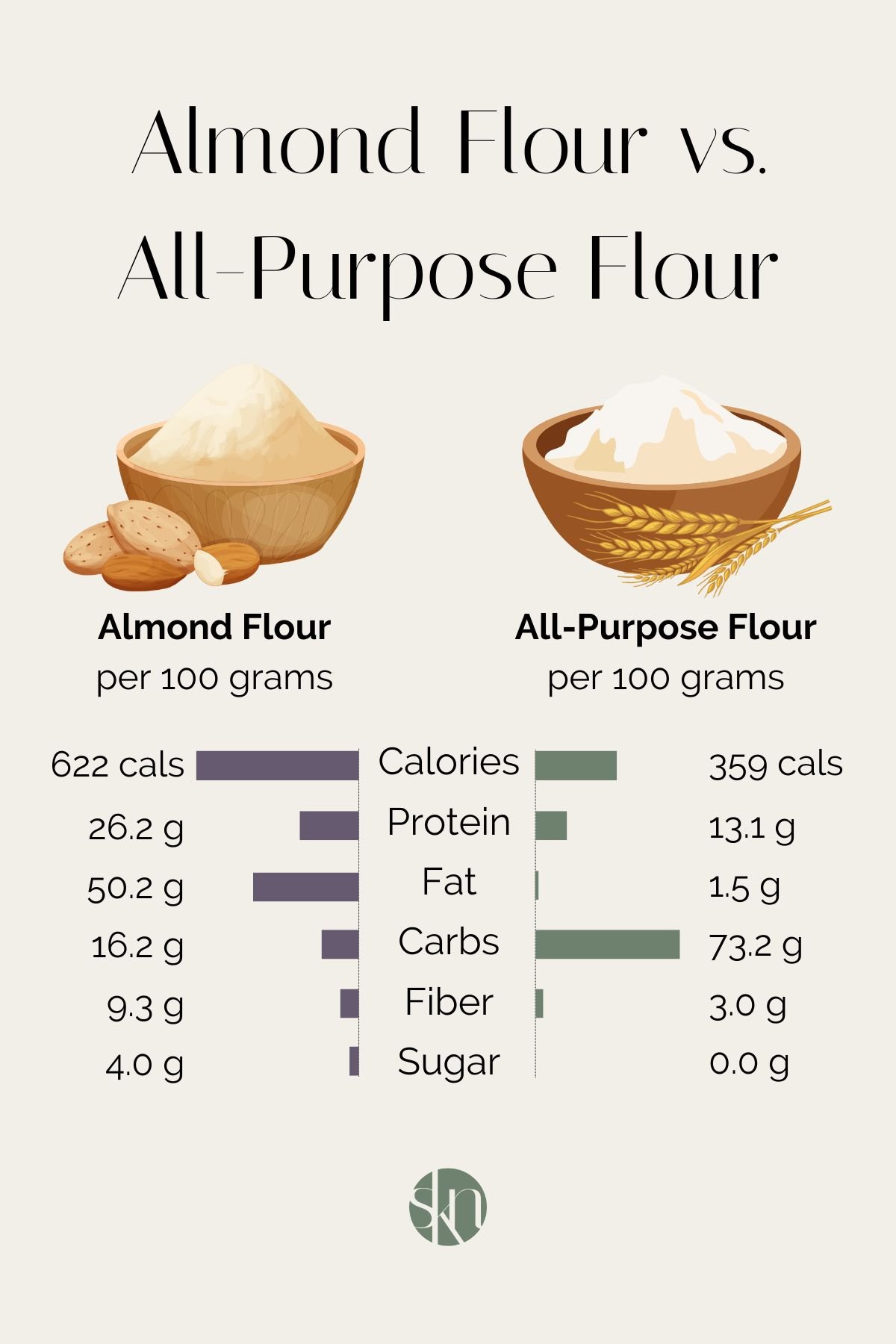
Here is a nutrition comparison of calorie, macronutrient, and micronutrient content of 100 grams of almond flour vs. all-purpose flour (1, 2, 3, 4).
| Nutrition per 100 grams | Almond Flour | All-Purpose Flour |
| Calories | 622 calories | 359 calories |
| Protein | 26.2 grams | 13.1 grams |
| Fat | 50.2 grams | 1.5 grams |
| Carbohydrates | 16.2 grams | 73.2 grams |
| Fiber | 9.3 grams | 3.0 grams |
| Sugar | 4.0 grams | 0.0 grams |
Calories
Almond flour contains significantly more calories than all-purpose flour. A 100-gram serving of almond flour contains 622 calories, while a 100-gram serving of all-purpose flour contains 359 calories.
Protein
Almond flour contains twice as much protein as all-purpose flour. A 100-gram serving of almond flour contains 26.2 grams of protein, while a 100-gram serving of all-purpose flour contains 13.1 grams of protein.
Fat
Almond flour contains a lot more fat than all-purpose flour. A 100-gram serving of almond flour contains 50.2 grams of fat, while a 100-gram serving of all-purpose flour contains 1.5 grams of fat.
Almond flour is a good source of healthy fats, with a content of roughly 80% monounsaturated fats and limited saturated fat (5). The high fat content of almond flour is also what makes it high in calories, as fats are the highest-calorie macronutrient, providing 9 calories per gram, compared to the 4 calories per gram from protein and carbohydrates (6).
Carbohydrates
Almond flour is much lower in carbohydrates than all-purpose flour. A 100-gram serving of almond flour contains 16.2 grams of carbohydrates, while a 100-gram serving of all-purpose flour contains 73.2 grams of carbohydrates.
This is largely because almonds are primarily a source of fat, while wheat kernels are primarily a source of complex carbohydrates.
Fiber
Almond flour contains more fiber than all-purpose flour. A 100-gram serving of almond flour contains 9.3 grams of fiber, while a 100-gram serving of all-purpose flour contains 3.0 grams of fiber.
Both almond flour and all-purpose flour contain a mix of soluble and insoluble fiber. Although the exact ratio can vary, almond flour contains insoluble fiber, with a smaller amount of soluble fiber, while all-purpose flour contains a significantly higher proportion of insoluble fiber compared to soluble fiber.
Sugar
Almond flour contains more sugar than all-purpose flour. A 100-gram serving of almond flour contains 4.0 grams of sugar, while a 100-gram serving of all-purpose flour contains 0 grams of sugar. The sugar content in almond flour is from natural sugars, not added sugars.
Vitamins and Minerals
Both almond flour and all-purpose flour are good sources of micronutrients. Almond flour is a good source of vitamin E, magnesium, manganese, copper, and zinc, while all-purpose flour is a good source of thiamin, selenium, and folate.
In the United States and Canada, almost all-purpose flour is enriched and fortified with B vitamins, thiamin, riboflavin, niacin, and folic acid, and iron to increase its nutritional content (7, 8).
Other Factors to Consider
In addition to nutritional benefits, here are some other factors to consider between almond flour and all-purpose flour.
Dietary Needs
Almond flour is naturally gluten-free, making it a great flour alternative for individuals with celiac disease or gluten intolerance, along with oat flour, coconut flour, and rice flour. Its low-carb and high-fat content also makes it a good option for those following a low-carb diet, or a grain-free diet such as the paleo diet or keto diet.
While all-purpose flour naturally contains gluten, it may be a better option for individuals with nut allergies.
Structure
Although almond flour’s lack of gluten makes it more accessible for dietary needs, it does affect the structure of baked goods. Without gluten’s binding power, gluten-free flours like almond flour generally result in denser and crumblier muffins, cakes, and cookies compared to all-purpose flour.
Conversely, all-purpose flour contains gluten, which creates well-structured, light, and airy baked goods. All-purpose flour is made from a combination of high-protein (hard wheat) and low-protein (soft wheat) flour, which creates a more versatile flour that can be used in everything from bread to muffins and pizza crust.
All-purpose flour has a moderate protein content of about 10-12% (9). Flours with a high protein content offer more gluten development, which creates more extensibility and elasticity in the dough and are great for bread, while flours with lower protein content create softer and more tender baked goods.
Shelf Life
Due to its high-fat content, almond flour has a shorter shelf life than all-purpose flour. Opened almond flour can last for several months in an airtight container in the pantry or up to 6 months in the refrigerator. Opened all-purpose flour can last 6-8 months in an airtight container in the pantry or up to 12 months in the refrigerator.
Can you substitute almond flour for all-purpose flour in recipes?
While almond flour can be used as a substitution for all-purpose flour in most recipes, it cannot always be used in a 1-to-1 ratio. Due to its lack of gluten and higher fat content, almond flour must be combined with other ingredients to avoid a greasy, dense, and/or chewy texture.
The exact method to substitute almond flour will vary by recipe, as you may need to combine almond flour with other gluten-free flours, baking powder, and/or additional binding agents, such as xanthan gum, guar gum, and psyllium husk.
So, is almond flour healthier than all-purpose flour?
Overall, both almond flour and all-purpose flour are healthy options and provide many health benefits. The “best” option comes down to the individual’s preferences, dietary needs, and health goals. Almond flour is higher in protein and fiber and lower in carbohydrates, while all-purpose flour is lower in calories and lower in fat.
Almond flour is a better option for individuals who need to eat gluten-free, but all-purpose flour may be a more practical option for those seeking a lower-calorie option to support a calorie deficit or maintain weight loss.

The Bottom Line
Almond flour is a gluten-free flour made from ground, blanched almonds, and all-purpose flour is a refined wheat flour. Almond flour is higher in calories, fat, protein, and fiber and lower in carbohydrates, while all-purpose flour is lower in calories and sugar. Both are good sources of vitamins and minerals and can be included in a healthy and balanced diet.



This article is very helpful. Deciding what to choose is a hard decision. One question remains for me: Do they taste the same? I’m sorry if you mentioned it and I missed it. I never knew the measurements were not the same. Now I know why I had chewy bans bread. Tanks for he article.
I’m glad you found it helpful, Sheila!
To answer your question, yes, there is a difference in flavor as well. Almond flour has a subtle nutty flavor, while all-purpose flour has a mild, neutral taste.
Very informative about the differences between the two flours that I did not know!
Stephanie, I always appreciate your nutritional knowledge you share with your readers. Thank you, Janis
My pleasure, Janis! I’m so happy you find the information helpful. 🙂