

Oat milk and almond milk are two of the most popular milk alternatives in the modern market, but which one is healthier? Here is a comparison and nutritional breakdown of oat milk vs. almond milk.
Table of contents
What’s the difference between oat milk and almond milk?
Oat milk and almond milk are plant-based milk alternatives. While similar in their production method, these non-dairy milks differ in their primary ingredient, taste, texture, and nutritional value.
Oat milk and almond milk are both produced using a similar method: soaking the main ingredient (oats or almonds) in water, blending the mixture, and then straining the liquid to remove the solid pulp.
The key difference between oat and almond milk lies in how much water each ingredient absorbs. Oats absorb significantly more water than almonds do, which means a greater proportion of the original oat material remains in the final oat milk product compared to the amount of almond material found in almond milk.
Ingredients in Oat Milk vs. Almond Milk
While homemade oat and almond milk require only their namesake ingredient and water, commercially produced versions involve additional ingredients and steps to make these processed foods.
Although the exact process will vary by brand, commercial varieties are generally treated with enzymatic hydrolysis to improve digestibility, stability, and texture (mouthfeel), fortified to match the nutrient profile of cow’s milk, and homogenized to ensure a consistent texture and prevent the liquid from separating (1, 2, 3). Moreover, many varieties contain added oils, salt, gums, sugar, and flavor to improve the texture and flavor. This is also common in other milk alternatives, such as soy milk and coconut milk.
Here are the ingredients in the most popular US oat milk brands (4, 5, 6, 7):
- Chobani Oatmilk: Oat Blend (Water, Whole Grain Oats), Contains 2% or less of: Rapeseed Oil, Sea Salt, Vitamin D2 (Yeast Extract), Calcium Carbonate, Gellan Gum.
- Planet Oatmilk: Oatmilk (Filtered Water, Oats), Calcium Carbonate, Dipotassium Phosphate (stabilizer), Sea Salt, Gellan Gum, Vitamin A Palmitate, Vitamin D2, Riboflavin (Vitamin B2), Vitamin B12.
- Oatly Oat Drink: Oat Base (Water, Gluten-Free Oats), Contains 2% or less of: Low Erucic Acid Rapeseed Oil, Dipotassium Phosphate, Calcium Carbonate, Tricalcium Phosphate, Sea Salt, Dicalcium Phosphate, Zinc, Riboflavin, Vitamin A, Vitamin D2, Vitamin B12.
Here are the ingredients in the most popular US almond milk brands (4, 8, 9, 10):
- Silk Almond Milk: Almondmilk (Filtered Water, Almonds), Cane Sugar, Contains 2% or Less of: Vitamin and Mineral Blend (Calcium Carbonate, Vitamin E Acetate, Vitamin A Palmitate, Vitamin D2), Sea Salt, Gellan Gum, Ascorbic Acid (Vitamin C to Protect Freshness), Natural Flavor.
- Blue Diamond Almond Milk: Almondmilk (Filtered Water, Almonds), Calcium Carbonate, Sea Salt, Potassium Citrate, Sunflower Lecithin, Gellan Gum, Natural Flavors, D-Alpha-Tocopherol (Natural Vitamin E).
- Califa Farms Almond Milk: Almondmilk (Water, Almonds), Calcium Carbonate, Sunflower Lecithin, Sea Salt, Natural Flavor, Guar Gum, Gellan Gum, Vitamin A Palmitate, Vitamin D2, Potassium Citrate.
Oat Milk vs. Almond Milk: Nutrition
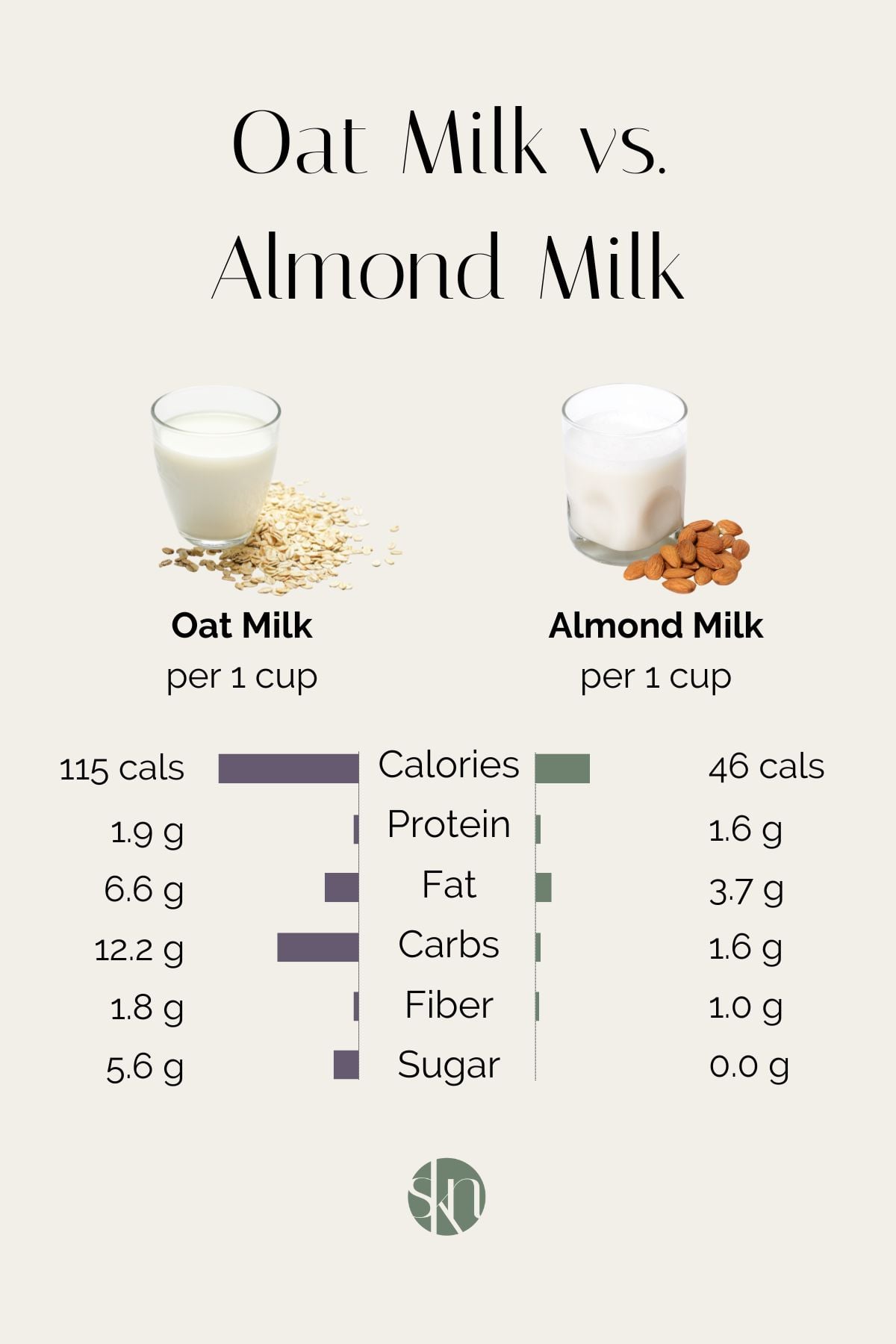
Here is a comparison of the nutritional value of 1 cup (240 ml) of plain, unsweetened oat milk vs. plain, unsweetened almond milk (11, 12).
| Nutrition per 1 cup (240ml) | OAT MILK | ALMOND MILK |
| Calories | 115 calories | 46 calories |
| Protein | 1.9 grams | 1.6 grams |
| Fat | 6.6 grams | 3.7 grams |
| Carbohydrates | 12.2 grams | 1.6 grams |
| Fiber | 1.8 grams | 1.0 grams |
| Sugar | 5.6 grams | 0.0 grams |
Calories
Oat milk contains more calories than almond milk. A 1-cup serving of oat milk contains 115 calories, while a 1-cup serving of almond milk contains 46 calories.
Given that oat milk contains more oats than almond milk contains almonds, oat milk retains more macronutrients overall, which contributes to its higher calorie content.
Protein
Oat milk and almond milk contain similar amounts of protein; however, neither is a significant source of protein. A 1-cup serving of oat milk contains 1.92 grams of protein, and a 1-cup serving of almond milk contains 1.58 grams of protein.
While almonds are one of the best sources of plant-based protein and contain more protein per serving than oats, because there are more oats in oat milk than almonds in almond milk, the protein content of oat milk is higher.
Fat
Oat milk contains more fat than almond milk. A 1-cup serving of oat milk contains 6.60 grams of fat, and a 1-cup serving of almond milk contains 3.74 grams of fat.
The fat content in almond milk is provided by the natural, healthy fats found in almonds, while most of the fat content in oat milk is from added vegetable oils, as oats contain minimal amounts of fat.
Carbohydrates
Almond milk contains fewer carbohydrates than oat milk. A 1-cup serving of oat milk contains 12.24 grams of carbohydrate, and a 1-cup serving of almond milk contains 1.61 grams of carbohydrate.
Oats are primarily a source of carbohydrates, while almonds are primarily a source of fat; hence, oat milk contains more carbohydrates than almond milk.
Fiber
Oat milk typically contains slightly more fiber than almond milk; however, neither is a significant source of fiber. A 1-cup serving of oat milk contains 1.80 grams of fiber, and a 1-cup serving of almond milk contains 0.96 grams of fiber.
While oats and almonds are both good sources of fiber, oats contain more fiber, and more oats make their way into the milk; therefore, oat milk is higher in fiber than almond milk, specifically beta-glucan, a heart-healthy soluble fiber. Although the primary ingredient in both almond milk and oat milk is water, very little fiber is transferred from oats and almonds to their final milk products.
Sugar
Oat milk contains more sugar than almond milk. A 1-cup serving of oat milk contains 5.57 grams of sugar, and a 1-cup serving of almond milk contains 0.00 grams of sugar.
Oat milk contains more natural sugars than almond milk because the processing of oats to make oat milk involves breaking down starches into simple sugars through an enzymatic process that naturally sweetens the milk.
Micronutrients
Homemade or unfortified brands of oat milk and almond milk are not particularly rich sources of micronutrients; however, most store-bought versions are fortified with vitamins and minerals to match the nutritional profile of regular milk.
Oat milk naturally contains more iron and phosphorus, while almond milk naturally contains more vitamin E, but both are fortified with calcium, vitamin A, vitamin D, and/or vitamin B12.
Other Factors to Consider
Here are some additional things to consider in the almond and oat milk debate.
Dietary Preferences
An individual’s dietary preferences and health goals may impact the choice between non-dairy milks. While oat milk and almond milk are suitable for individuals following a plant-based or vegan diet, almond milk may be more suitable for individuals managing blood sugar levels or following a low-carb diet or ketogenic diet, or looking to create a calorie deficit to support weight loss.
Allergies
Oat and almond milk are excellent dairy alternatives for individuals avoiding lactose, as both are completely lactose-free. For those with gluten sensitivities or celiac disease, both options are also suitable, provided oat milk is made with certified gluten-free oats. For individuals with tree nut allergies, almond milk is not a safe option and, while oat milk is nut-free, it is best to read the label because some commercial oat milks may be processed in facilities that also handle nuts, which could lead to cross-contamination.
Taste
Overall, oat milk has a stronger flavor than almond milk. Oat milk has a naturally sweet and oaty flavor, while almond milk has a milk and nutty flavor.
Texture
Oat milk generally has a richer texture than almond milk. Oat milk has a creamy and smooth texture, similar to traditional dairy milk, while almond milk has a more watery texture and thinner consistency.
Uses
Both oat milk and almond milk can be used as alternatives to traditional dairy milk in your morning coffee, cereal, smoothies, mashed potatoes, creamy soups, sauces, or baked goods. Baristas and coffee shops tend to prefer oat milk over almond milk for espresso drinks because of its creamy texture and ability to steam, which makes it ideal for latte art.
Environmental Impact
Oat milk is generally considered to have a lower environmental impact than almond milk. Oat milk requires significantly lower water usage than almond milk and has a relatively low greenhouse footprint; however, almond milk generally has lower CO2 emissions (13).
One concern with oat milk is that some conventional oats have been shown to be contaminated with unsafe levels of glyphosate; however, this can be mitigated by choosing organic varieties.
So, is oat milk healthier than almond milk?
Overall, both oat milk and almond milk are healthy options; one is not healthier than the other. The “best” option depends on your dietary needs, calorie intake, macro needs, and personal preferences.
Oat milk is higher in calories, fat, carbohydrates, fiber, iron, and phosphorus, while almond milk is higher in vitamin E. Oat and almond milk contain similar levels of protein, calcium, Vitamin A, Vitamin D, and Vitamin B12.
For individuals with nut allergies, oat milk is a better option, and for individuals with celiac disease, almond milk is likely a better option. For individuals following a plant-based or vegan diet, almond or oat milk are good options.

The Bottom Line
Oat milk and almond milk are plant-based milk alternatives and both can be included in a healthy diet. They are made from their namesake ingredient and water; however, commercial versions often contain added ingredients to improve flavor, texture, stability, and nutritional profile. Oat milk is higher in calories, fat, carbohydrates, and fiber, but oat and almond milk contain similar levels of protein. Regardless of the option you choose, it is best to read the ingredients and opt for varieties with minimal added sugar.



Love your site and all your recipes and tips. How about including our own Canadian brand Earth’s Own in the completely unsweetened versions. In that case, there is very little difference between almond and oat milk. Without stating the exact brand, it is impossible to properly compare.
Thanks for your feedback, Tracy.
To clarify, I’ve actually noted multiple times in the article that the exact nutritional values will vary by brand. Moreover, the “Ingredients in Oat Milk vs. Almond Milk” lists the ingredients of the most popular brands in detail.
And, to confirm, as noted below the infographic/above the chart, the nutritional values are for versions without added sugar, specifically, plain, unsweetened oat milk vs. plain, unsweetened almond milk. Oat milk inherently contains more natural (not added) sugar than almond milk, which is why Earth’s Own Oat Milk contains 6 grams of sugar per serving, as noted here on their website.
Hi Steph
Love your recipes and great tips. Thank you. Wondering if you’ve done much research on Tiger Nut milk and how it compares to almond and oat?
Thanks
Thanks, Nicole, I’m so happy you enjoy the recipes and tips! Unfortunately, I don’t have a comparison for tiger nut milk.