

Whether you’re baking at home or trying to eat healthier, picking the right flour can be confusing. Here is a comparison and nutrition breakdown of all-purpose vs. whole wheat flour, so you can make the best choice for your health goals and baked goods.
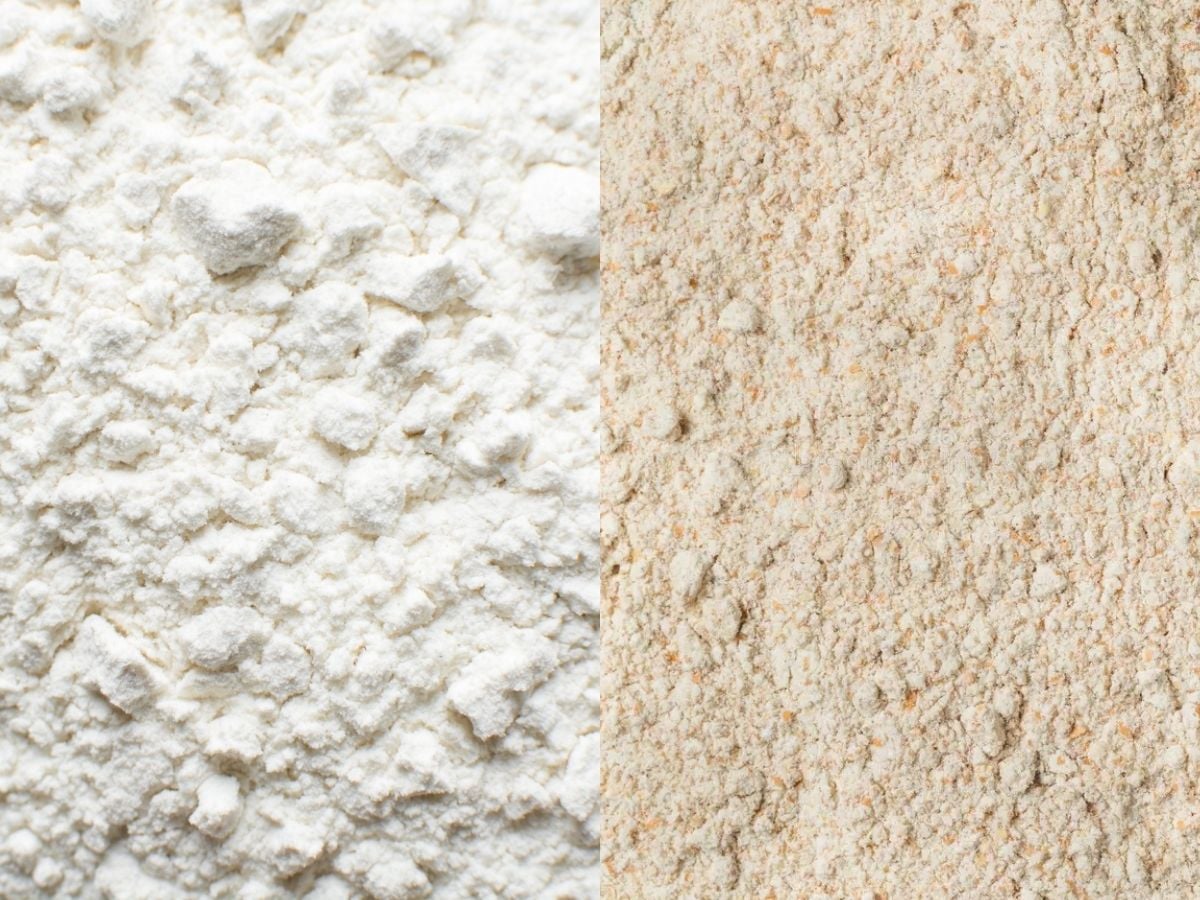
Table of contents
What’s the difference between all-purpose and whole wheat flour?
The core difference between all-purpose flour and whole wheat flour lies in how much of the wheat kernel (wheat berry) is used during the milling process. When harvested, a wheat kernel contains four primary parts (1):
- Hull: The inedible protective layer, which is removed during processing.
- Bran: The multi-layered thin outer skin that contains antioxidants, B vitamins, and fiber.
- Germ: The embryo that sprouts when planted in soil that contains B vitamins, some protein, minerals, and healthy fats.
- Endosperm: The starchy middle layer and by far the largest portion of the grain that contains complex carbohydrates, proteins, and small amounts of vitamins and minerals.
All-purpose flour, also known as white flour or refined flour, is made by milling only the endosperm part of the grain. The bran and germ are removed during milling, which creates a pale, fine-textured flour with a milder taste. It’s also made from a mixture of hard and soft wheat to achieve its ideal protein content (10-12%) and long, stretchy gluten strands.
Whole wheat flour, as the name implies, is made by milling the whole grain: endosperm, bran, and germ. The use of the whole grain creates a darker, coarser flour with a stronger taste. It also has a higher protein content (13-15%), but shorter, more easily torn gluten strands.
| Type of Flour | All-Purpose Flour | Whole Wheat Flour |
| Source | Wheat | Wheat |
| Composition | Endosperm only | Endosperm, bran, and germ |
| Protein Content | Lower protein content (10-12%) | Higher protein content (13-15%) |
| Gluten Behavior | Smooth, elastic, medium gluten strands | Sharp bran cuts gluten strands |
| Texture | Soft, very fine | Coarser, grittier |
| Flavor | Mild, neutral | Nutty, earthy |
It should be noted that there is a white version of whole wheat flour, known as “white whole wheat flour,” which is milled from whole grains (endosperm, bran, and germ), but it is made from hard white spring wheat instead of traditional red wheat. While its name contains the word “white”, it is in fact a whole wheat flour.
All-Purpose vs. Whole Wheat Flour: Nutrition
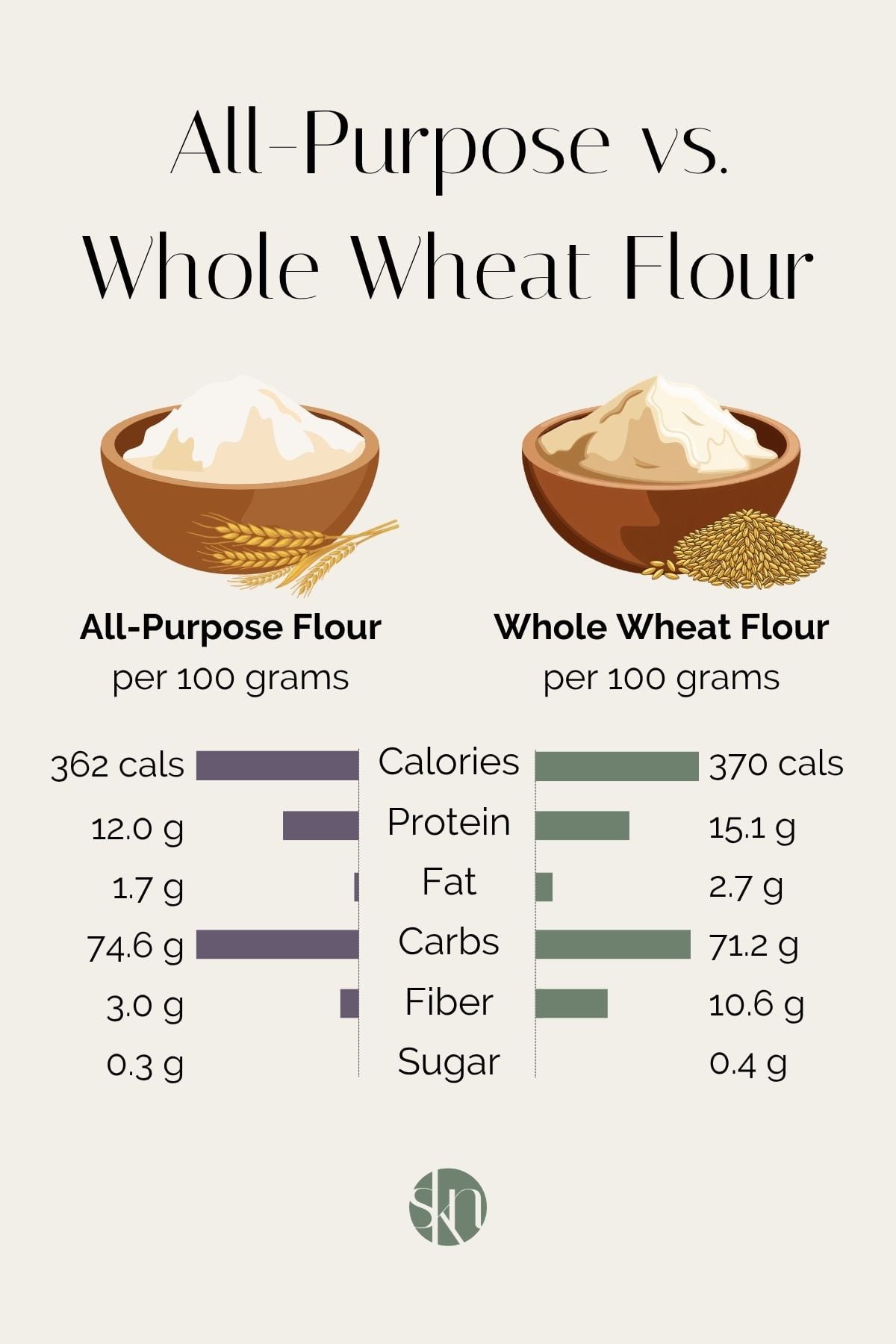
Here is a nutrition comparison of the calorie and macronutrient content of 100 grams of all-purpose flour vs. whole wheat flour (2, 3, 4, 5).
| Nutrition per 100 grams | All-Purpose Flour | Whole Wheat Flour |
| Calories | 362 calories | 370 grams |
| Protein | 12.0 grams | 15.1 grams |
| Fat | 1.7 grams | 2.7 grams |
| Carbohydrate | 74.6 grams | 71.2 grams |
| Fiber | 3.0 grams | 10.6 grams |
| Sugar | 0.3 grams | 0.4 grams |
Calories
All-purpose and whole wheat flour contain a similar number of calories. A 100-gram serving of all-purpose flour contains 362 calories, while a 100-gram serving of whole wheat flour contains 370 calories.
Protein
Whole wheat flour contains slightly more protein than all-purpose flour. A 100-gram serving of all-purpose flour contains 12.0 grams of protein, while a 100-gram serving of whole wheat flour contains 15.1 grams of protein.
Fat
Whole wheat flour contains more fat than all-purpose flour. A 100-gram serving of all-purpose flour contains 1.7 grams of fat, while a 100-gram serving of whole wheat flour contains 2.7 grams of fat.
Carbohydrates
All-purpose and whole wheat flour contain a very similar amount of carbohydrate. A 100-gram serving of all-purpose flour contains 74.6 grams of carbohydrate, while a 100-gram serving of whole wheat flour contains 71.2 grams of carbohydrate.
Fiber
Whole wheat flour contains far more fiber than all-purpose flour. A 100-gram serving of all-purpose flour contains 3.0 grams of fiber, while a 100-gram serving of whole wheat flour contains 10.6 grams of fiber.
The high fiber content in whole wheat flour slows nutrient absorption, which helps balance blood sugar levels. Moreover, whole wheat flour is rich in insoluble fiber, a nutrient well-known for promoting digestive regularity.
Sugar
All-purpose and whole wheat flour contain a very similar amount of sugar; however, neither is a significant source. A 100-gram serving of all-purpose flour contains 0.3 grams of sugar, while a 100-gram serving of whole wheat flour contains 0.4 grams of sugar.
The sugar content in all-purpose flour and whole wheat flour is naturally occurring from natural sugars, not added sugars.
Vitamins & Minerals
Here is a micronutrient comparison of a 100-gram serving of unenriched all-purpose flour vs. unenriched whole wheat flour (2, 3).
| Nutrition per 100 grams | All-Purpose Flour | Whole Wheat Flour |
| Calcium | 22 mg | 38.0 mg |
| Iron | 1.2 mg | 3.9 mg |
| Magnesium | 36.1 mg | 136.0 mg |
| Phosphorus | 134.0 mg | 352.0 mg |
| Potassium | 150 mg | 376.0 mg |
| Zinc | 1.2 mg | 3.2 mg |
| Manganese | 0.8 mg | 3.6 mg |
| Selenium | 20.1 µg | 23.6 µg |
| Thiamin (Vitamin B1) | 0.3 mg | 0.5 mg |
| Riboflavin (Vitamin B2) | 0.0 mg | 0.1 mg |
| Niacin (Vitamin B3) | 1.6 mg | 5.6 mg |
| Vitamin B6 | 0.1 mg | 0.3 mg |
| Folate (Vitamin B9) | 23.0 µg | 39.0 µg |
Whole wheat flour contains significantly more vitamins and minerals than all-purpose flour, because it contains the nutrient-dense bran and germ. Whole wheat flour is a good source of B vitamins, namely thiamin (B1), niacin (B3), and folate (B9), as well as calcium, iron, magnesium, phosphorus, potassium, zinc, and selenium.
That said, all-purpose flour and other white flours are legally required to be fortified and enriched with specific vitamins and minerals in the United States and Canada (6). Both countries require white (refined) wheat flour to be fortified with iron and four B vitamins (thiamin, riboflavin, niacin, and folic acid), while calcium can be added voluntarily.
Other Factors to Consider
Here are some other factors to consider in the all-purpose flour vs. whole wheat flour comparison.
Absorbency
Because it contains the bran and germ, whole wheat flour absorbs significantly more liquid than all-purpose flour, as it acts like a sponge. For this reason, recipes using whole wheat flour generally need more liquid, and dough may require longer rest periods.
Rise
While whole wheat flour ferments and rises faster, due to its nutrient-rich bran and germ accelerating yeast activity, it produces a denser, tighter, and heavier crumb because the sharp bran fragments cut the gluten strands and block them from stretching.
In contrast, all-purpose flour allows a stronger, uninterrupted gluten network to form smoothly. Even though it may ferment slightly slower, this clean structure traps gas bubbles far more effectively, ultimately yielding a taller, lighter, and fluffier texture with a more tender crumb.
Shelf Life
All-purpose flour has a longer shelf life than whole wheat flour. Given that whole wheat flour retains the bran and germ, it also retains more natural oils and fats, which can oxidize and turn rancid faster when exposed to air, light, and warmth. All-purpose flour typically lasts 6 to 12 months in a pantry at room temperature, while whole wheat flour lasts only 3 to 6 months (7).
FAQs
Yes, you can swap all-purpose flour for whole wheat flour in recipes. However, it will affect the texture, taste, and density of baked goods. For instance, using whole wheat flour in a bread recipe will turn white bread into whole wheat bread and create a flatter bread with a tighter and denser crumb.
In general, you can substitute all-purpose and whole wheat flour in a 1:1 ratio in most recipes; however, you may need to alter other parts of the recipe, particularly the liquid. For the best results, replace only 50% of the all-purpose flour with whole-wheat flour 1:1 without changing anything else.
A flour’s protein content dictates the gluten development, extensibility, and elasticity in dough, which affects the structure, chew, and tenderness of baked goods. For example, the higher protein content of bread flour offers strength, a higher rise, and chewiness in bread, while the lower protein content of pastry flour offers a tender, delicate, and flaky texture in baked goods.
So, which is healthier?
Whole wheat flour is generally considered healthier than all-purpose flour. While they contain a similar amount of calories and carbohydrates per serving, whole wheat flour contains more protein, more fiber, and more iron, magnesium, B vitamins, and antioxidants than all-purpose flour.
That said, overall, both flours are considered healthy flours and can be included in a healthy and balanced diet, and can support a weight loss goal as long as you maintain a calorie deficit.
Usage Tips
All-purpose flour is suitable for baking a wide range of items, including cookies, muffins, cakes, and thickening sauces, while whole wheat flour is best used for rustic baked goods and quick breads.
If a recipe calls for all-purpose flour, but you’d prefer to use whole wheat flour, here are some tips to consider:
- Add two additional teaspoons of water (liquid) for each cup of whole wheat flour.
- Allow an extra 20 to 25 minutes of rest before kneading whole wheat dough.
- Expect shorter rise times when using whole wheat flour.
- A 50/50 blend of all-purpose flour and whole wheat flour can increase fiber content while maintaining lightness.

The Bottom Line
All-purpose flour is a refined white flour made from wheat’s endosperm, while whole wheat flour is a whole grain flour made from wheat’s bran, germ, and endosperm. Overall, whole wheat flour is more nutrient-dense, as it contains more protein, fiber, and micronutrients; however, both can be included in a healthy diet.




Leave a Review