

The debate as to whether eggs or eggs white are healthier is longstanding, with some experts advising to discard the yolk to save on calories, and others defending it as a nutrient-dense powerhouse. Here is a comparison of the nutritional value of whole eggs vs. egg whites, so you can make the best choice for your health and goals.

Table of contents
What’s the difference between whole eggs and egg whites?
Whole eggs consist of both the yolk and the white, whereas egg whites refer only to the white portion. Although both come from the same package, they have completely different nutritional profiles and culinary purposes.
The whole egg contains the yolk, which is the nutrient hub of the egg. It is designed by nature to supply life-giving nutrients and houses all of the essential fatty acids, fat-soluble vitamins, and antioxidants.
The white, also known as the albumen, is the clear liquid layer around the yolk and is made up of roughly 90% water and 10% pure protein. Its primary biological function is to cushion the yolk and ward off harmful bacteria (1).
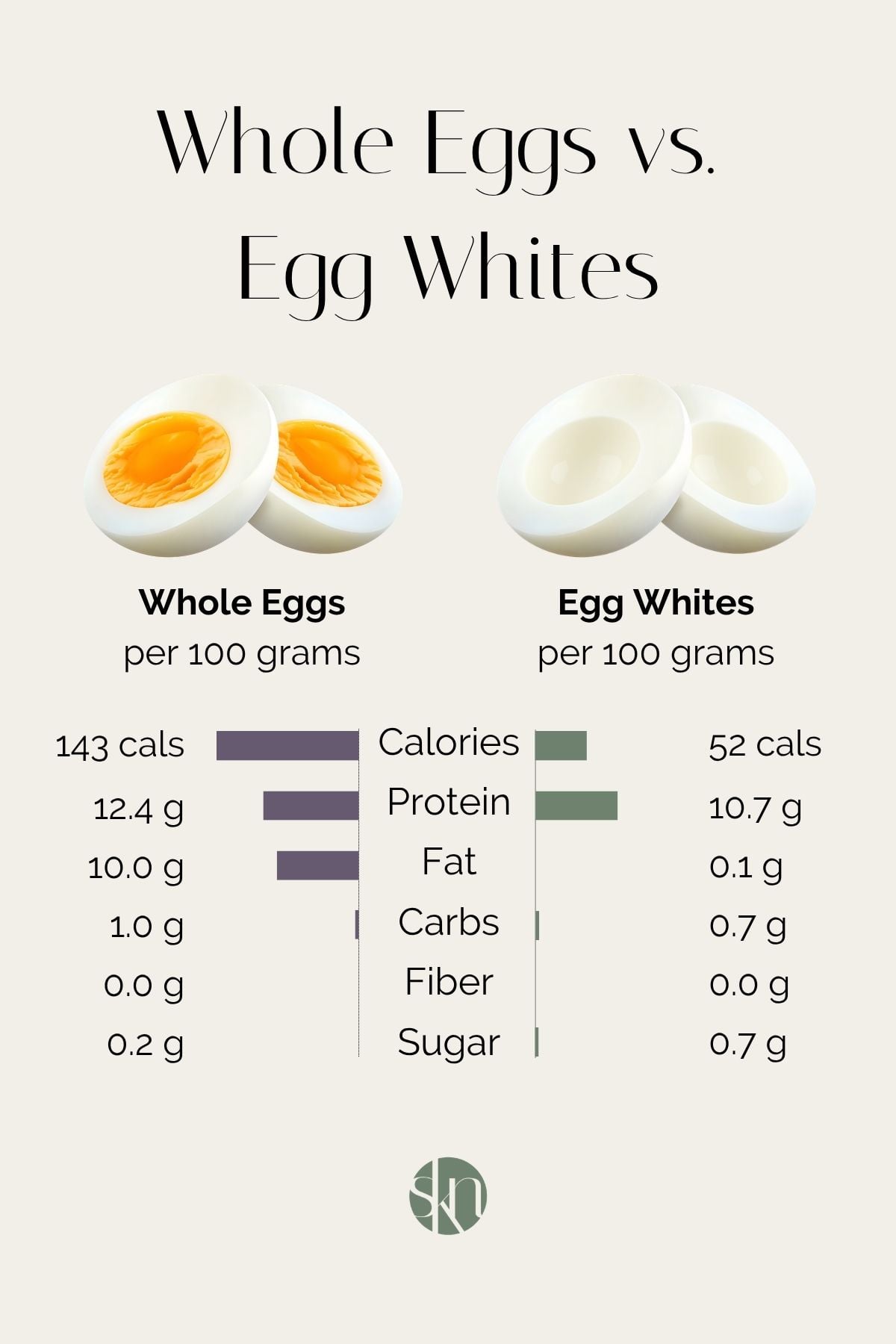
Whole Eggs vs. Egg Whites: Nutrition
Here is a nutrition comparison of the calorie and macronutrient content of 100 grams of whole eggs vs. egg whites (2, 3, 4, 5).
| Nutrition per 100 grams | Whole Eggs | Egg Whites |
| Calories | 143 calories | 52 calories |
| Protein | 12.4 grams | 10.7 grams |
| Fat | 10.0 grams | 0.1 grams |
| Carbohydrates | 1.0 grams | 0.7 grams |
| Fiber | 0.0 grams | 0.0 grams |
| Sugar | 0.2 grams | 0.7 grams |
Calories
Egg whites contain fewer calories than whole eggs. A 100-gram serving of whole eggs contains 143 calories, while a 100-gram serving of egg whites contains 52 calories.
The calorie difference is largely due to the egg yolks in whole eggs, which are a rich source of fat, the most calorie-dense macronutrient.
Protein
Whole eggs contain more protein than egg whites. A 100-gram serving of whole eggs contains 12.4 grams of protein, while a 100-gram serving of egg whites contains 10.7 grams of protein.
Both whole eggs and egg whites are complete proteins containing all essential amino acids. However, egg whites are almost pure protein, accounting for roughly 60% of the egg’s total protein content (4).
Fat
Whole eggs contain more fat than egg whites. A 100-gram serving of whole eggs contains 9.96 grams of fat, while a 100-gram serving of egg whites contains 0.08 grams of fat.
Almost all the fat in an egg is in the yolk, which consists of roughly two-thirds unsaturated fat and one-third saturated fat.
Carbohydrates
Whole eggs contain more carbohydrates than egg whites; however, neither is a significant source. A 100-gram serving of whole eggs contains 0.96 grams of carbohydrate, while a 100-gram serving of egg whites contains 0.73 grams of carbohydrate.
Fiber
Neither whole eggs nor egg whites contain fiber.
Sugar
Egg whites contain slightly more sugar than whole eggs; however, neither is a significant source. A 100-gram serving of whole eggs contains 0.2 grams of sugar, while a 100-gram serving of egg whites contains 0.71 grams of sugar.
It’s also important to note that the sugar in eggs and egg whites is natural sugar, not added sugar.
Vitamins & Minerals
Here is a nutrition comparison of the micronutrient content of 100 grams of whole eggs vs. egg whites (2, 3, 4, 5).
| Nutrition per 100 grams | Whole Eggs | Egg Whites |
| Vitamin A | 180 mcg | 0 mcg |
| Vitamin D | 98.4 IU | 0 IU |
| Vitamin E | 1.05 mg | 0 mg |
| Vitamin K | 0.3 mcg | 0 mcg |
| Vitamin B12 | 1.02 mcg | 0.09 mcg |
| Folate | 71 mcg | 4 mcg |
| Choline | 335 mg | 1.1 mg |
| Calcium | 48 mg | 7 mg |
| Iron | 1.67 mg | 0.07 mg |
| Magnesium | 11.4 mg | 11 mg |
| Potassium | 132 mg | 163 mg |
| Selenium | 31.1 mcg | 20 mcg |
| Zinc | 1.24 mg | 0.03 mg |
Whole eggs contain more vitamins and minerals than egg whites. Egg yolks are the most micronutrient-dense part of the egg, containing nearly all of the vitamin D, vitamin A, vitamin B12 and other B vitamins, choline, iron, and antioxidants lutein and zeaxanthin (6).
Other Factors to Consider
Here are some other factors to consider in the egg whites vs. whole eggs debate.
Dietary Goals
While both whole eggs and egg whites fit into a healthy, balanced diet, an individual’s dietary and/or health goals can influence the choice.
For instance, individuals aiming for weight loss or a high-protein diet may prefer egg whites, as they are one of the best high-protein, low-calorie foods, while healthy adults looking to support overall wellness might find whole eggs a better fit.
Muscle Gain
Some research has shown that whole eggs trigger greater muscle protein synthesis – the process your body uses to build and repair lean muscle mass – than egg whites alone (7).
Cholesterol
Given that whole eggs contain almost all of the egg’s fat, they also contain all of the cholesterol. A serving of 2 large eggs contains 414 mg of cholesterol, while 2 egg whites contain 0 mg of cholesterol.
Although cholesterol has been demonized over the years, modern nutrition research has shown that dietary cholesterol does not significantly raise blood cholesterol levels or directly contribute to heart disease for most healthy adults (8, 9). For this reason, current health guidelines no longer set a specific, rigid daily numerical limit for dietary cholesterol intake.
That said, certain individuals and health conditions can benefit from limiting egg consumption, so it’s best to work with a health professional or registered dietitian to determine the best approach.
Allergies
Although rare, some individuals are highly allergic to eggs, with egg whites containing the vast majority of the egg’s reactive proteins. However, because it is impossible to completely separate the yolk from the white without cross-contamination, individuals with an egg allergy must avoid eggs entirely.
Experts also advise against consuming raw or undercooked eggs due to the risk of foodborne illnesses, such as salmonella (10).
Convenience
Using liquid egg whites, which are sold in cartons at most major grocery stores, can help save time and reduce cleanup compared to cracking or separating shells from whole eggs.
FAQS
The egg yolk is the most nutrient-dense part of an egg, containing almost all of the vitamins, minerals, and antioxidants.
Bodybuilders often opt for egg white over whole eggs because they contain fewer calories per gram of protein. For this reason, they are a great way to increase protein intake while minimizing fat and calorie intake during a “cutting” phase.
The whites from 2 whole eggs, or 1/4 cup liquid egg whites, equate to one whole egg.
So, which is healthier?
Whole eggs contain more high-quality protein, healthy fats, vitamins, minerals, and antioxidants than egg whites, making them a healthier choice overall.
That said, both egg whites and whole eggs are healthy foods and can be included in a healthy diet. Egg white may be more practical for supporting a calorie deficit; however, since egg whites lack fat-soluble vitamins, they must be obtained from other foods to meet dietary needs.

The Bottom Line
Ultimately, choosing between whole eggs and egg whites depends entirely on your personal health and fitness goals. While whole eggs contain more protein and essential nutrients, egg whites are lower in fat and calories. Fortunately, they can easily coexist in a balanced diet depending on whether you prioritize maximum micronutrient intake or strict calorie control.




Leave a Review