

Almond flour and coconut flour are often suggested as healthier alternatives to wheat flour, but which one wins the ultimate grain-free showdown? Here is a nutrition breakdown and comparison of almond flour vs. coconut flour, so you can make the best choice for your diet and health goals.
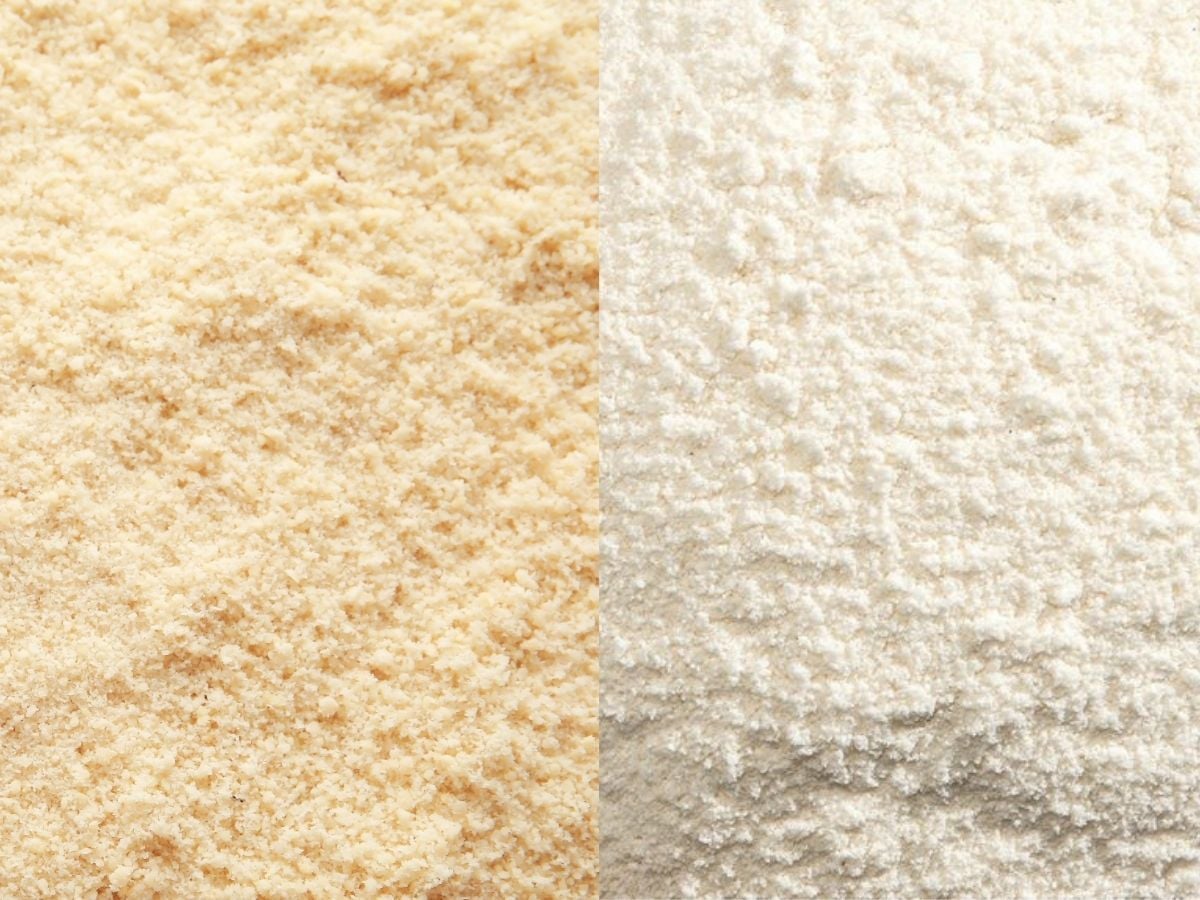
Table of contents
What’s the difference between almond flour and coconut flour?
Almond flour and coconut flour are popular alternatives to all-purpose flour; however, they differ in source, production method, nutrient profiles, and baking uses.
Almond flour is made from finely ground almonds. It is made by blanching whole, raw almonds in boiling water to remove their skin and then grinding them into a fine powder. Almond flour is naturally gluten-free and offers a subtle nutty flavor and tender, moist, but dense texture.
Coconut flour is made by grinding the leftover coconut pulp, also known as coconut “meat”, from coconut milk production. Once the liquid has been extracted from a coconut to make milk, the white fleshy bit remaining is dried at a low temperature and then ground into a fine powder. Coconut flour is naturally gluten-free and offers a sweet, floral, and tropical flavor, with a dense and slightly crumbly texture.
| Type of Flour | Almond Flour | Coconut Flour |
| Source | Almonds | Coconut |
| Production Method | Made by grinding blanched almonds into a fine powder | Made by grinding dried, defatted coconut meat |
| Taste | Nutty, slightly sweet | Sweet, floral, tropical |
| Baking Texture | Tender, moist, and dense | Dense, soft, and crumbly |
| Gluten Content | Gluten Free | Gluten Free |
Almond Flour vs. Coconut Flour: Nutrition
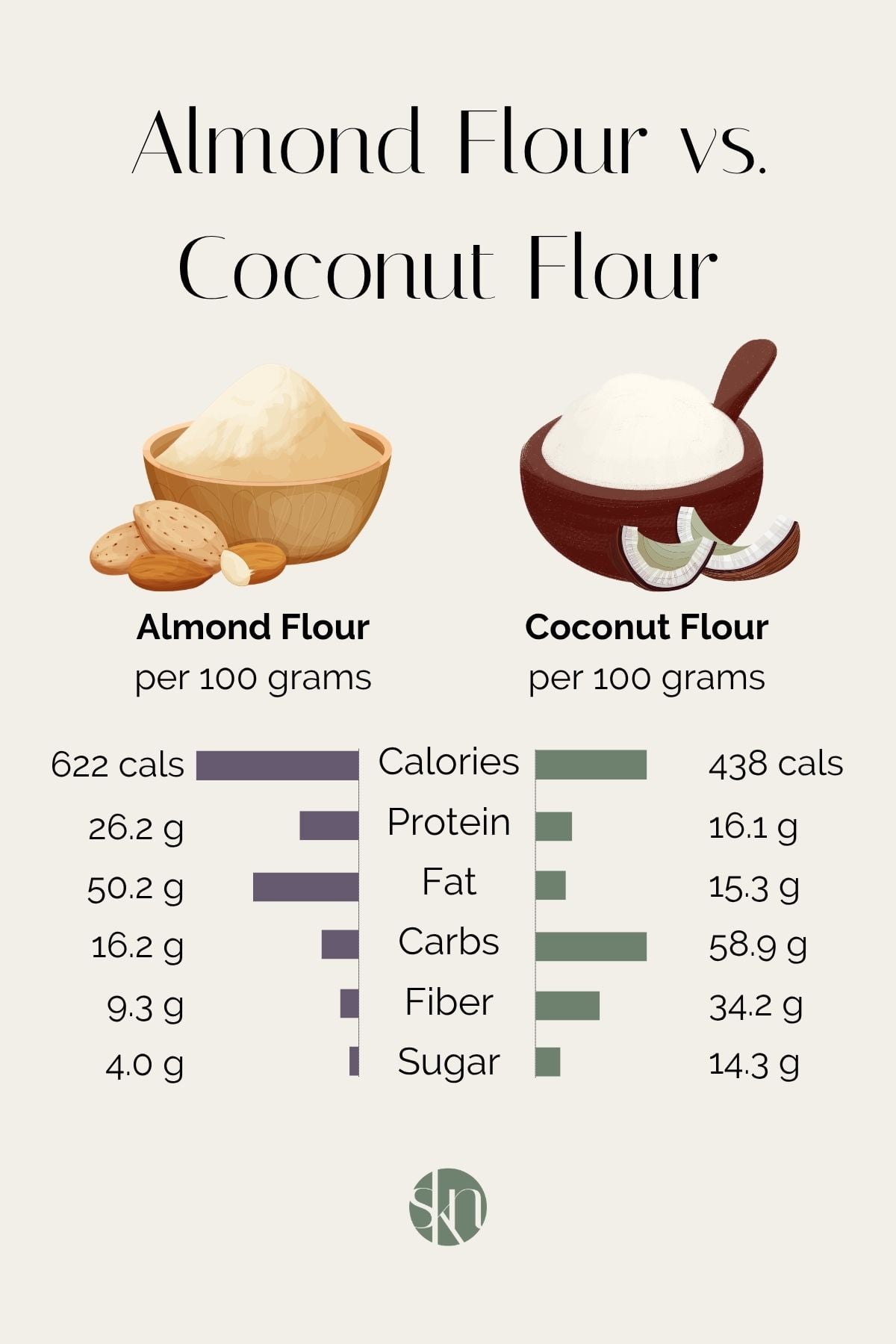
Here is a nutrition comparison of calorie, macronutrient, and micronutrient content of 100 grams of almond flour vs. coconut flour (1, 2).
| Nutrition per 100 grams | Almond Flour | Coconut Flour |
| Calories | 622 calories | 438 calories |
| Protein | 26.2 grams | 16.1 grams |
| Fat | 50.2 grams | 15.3 grams |
| Carbohydrates | 16.2 grams | 58.9 grams |
| Fiber | 9.3 grams | 34.2 grams |
| Sugar | 4.0 grams | 14.3 grams |
Calories
Almond flour contains more calories than coconut flour. A 100-gram serving of almond flour contains 622 calories, while a 100-gram serving of coconut flour contains 438 calories.
Protein
Almond flour contains more protein than coconut flour. A 100-gram serving of almond flour contains 26.2 grams of protein, while a 100-gram serving of coconut flour contains 16.1 grams of protein.
Almonds are one of the highest-protein nuts, second only to peanuts; therefore, almond flour is an excellent source of vegetarian protein and plant-based protein. Although coconut contains the word ‘nut,’ it is actually a fruit and, therefore, contains far less protein than almonds.
Fat
Almond flour contains a lot more fat than coconut flour, which contributes to its higher calorie content. A 100-gram serving of almond flour contains 50.2 grams of fat, while a 100-gram serving of coconut flour contains 15.3 grams of fat.
Both almond flour and coconut flour are good sources of healthy fats. Almonds are high in unsaturated fats in the form of monounsaturated fats, while coconuts are high in saturated fat in the form of medium-chain Triglycerides (MCTs), primarily lauric acid. MCTs differ from long-chain saturated fats found in animal products as they are rapidly digested and converted into energy, bypassing the usual fat digestion process, and have been shown to offer several health benefits, including improved muscle strength and function, improved cognitive performance, and increased fat oxidation (3).
That said, the high fat content of almond flour is also what makes it high in calories, as fats are the highest-calorie macronutrient, providing 9 calories per gram, compared to the 4 calories per gram from protein and carbohydrates (4).
Carbohydrates
Coconut flour contains far more carbohydrates than almond flour. A 100-gram serving of almond flour contains 16.2 grams of carbohydrates, while a 100-gram serving of coconut flour contains 58.9 grams of carbohydrates.
Given that coconuts are a fruit, they are primarily a source of complex carbohydrates, compared to almonds, which are a nut, and primarily a source of fat and protein.
Fiber
Coconut flour contains more fiber than almond flour. A 100-gram serving of almond flour contains 9.3 grams of fiber, while a 100-gram serving of coconut flour contains 34.2 grams of fiber.
Although both almonds and coconuts are high-fiber foods, coconut flour has more fiber than almond flour primarily due to how it is made. The leftover coconut “meat” used to make coconut flour has been defatted, which concentrates its structural plant cell walls, resulting in a higher fiber flour, namely in the form of insoluble fiber. None of the natural oils and fats are extracted from the almonds before they are ground into flour.
Sugar
Coconut flour contains more sugar than almond flour. A 100-gram serving of almond flour contains 4.0 grams of sugar, while a 100-gram serving of coconut flour contains 14.3 grams of sugar.
It’s important to note that the sugar in almond flour and coconut flour is naturally occurring; neither flour contains added sugars.
Vitamins & Minerals
Both almond flour and coconut flour are good sources of micronutrients. Almond flour contains more vitamin E, calcium, and phosphorus, while coconut flour contains more iron, potassium, copper, and zinc, and they contain a similar amount of magnesium.
Other Factors to Consider
Here are some other factors to consider when comparing almond and coconut flour.
Dietary Needs
Both almond flour and coconut flour are grain-free, gluten-free flours, making them good options for individuals with celiac disease or gluten allergies.
The low-carb content of almond flour also makes it a good option for individuals following a low-carb diet, or a grain-free diet such as the paleo diet or keto diet, while coconut flour is a good option for individuals with tree nut allergies.
Shelf Life
Almond flour has a shorter shelf life than coconut flour because it still contains all of its natural oils and fat, which increases its rate of spoilage. Opened almond flour can last for 2-4 months in an airtight container in the pantry or up to 6 months in the refrigerator. Opened coconut flour can last 6-8 months in an airtight container in the pantry or up to 12 months in the refrigerator.
Cost
Coconut flour is significantly cheaper than almond flour. Since coconut flour is a byproduct of coconut milk, it has lower production costs than almond flour, which requires growing, harvesting, and processing a resource-intensive crop.
On average, almond flour is 1.5 to 2 times more expensive than coconut flour. Almond flour ranges from $6.00 to $12.00 per pound, while coconut flour ranges from $3.00 and $6.00 per pound across major US retailers.
Can you substitute almond flour and coconut flour?
Unfortunately, you cannot swap almond flour and coconut flour in a 1:1 ratio in a recipe. Each flavor behaves differently as they have vastly different chemical properties, oil contents, and liquid absorption rates.
Coconut flour absorbs far more liquid than almond flour, up to four times more, and requires extra eggs to prevent crumbling in baked goods. In general, you can substitute coconut flour for almond flour, and vice versa, with a few simple recipe adjustments. For example:
If a baking recipe calls for almond flour and you want to use coconut flour, use 1/4 cup of coconut flour for every 1 cup of almond flour, add 1 egg for every 1/4 cup of coconut flour used, and add more liquid if the batter looks too thick.
If a baking recipe calls for coconut flour and you want to use almond flour, use 3 to 4 cups of almond flour for every 1 cup of coconut flour, reduce the number of eggs in the recipe by at least half, and reduce the liquid by roughly 1/3.
FAQs
Neither almond flour nor coconut flour is inherently better for weight loss. While coconut flour is generally lower in calories and higher in fiber, both flours can support weight loss when consumed as part of a healthy diet that creates a calorie deficit.
Yes, however, the exact method will vary by recipe, as you may need to combine almond flour and coconut flour with other flours, baking powder, and/or additional binding agents to achieve the desired results.
While similar, almond flour and almond meal are not the same. Almond flour is made from finely ground blanched almonds with the skins removed, while almond meal is made from ground whole, unpeeled almonds with the skin left on.
Bob’s Red Mill® is generally considered the best brand for both almond and coconut flour.
So, which is healthier?
In the coconut flour vs. almond flour debate, neither comes out on top. Both almond flour and coconut flour are healthy flours and minimally processed foods that offer many health benefits.
While almond more is more calorie-dense than coconut flour, it is lower in carbs, higher in protein, and full of healthy fats. Albeit, coconut flour is a better source of fiber, vitamins, and minerals.

The Bottom Line
Both almond flour and coconut flour are healthy alternative flours. Almond flour is made of finely ground blanched almonds, and coconut flour is made from defatted, dried coconut meat. Almond flour is a good source of protein and healthy fats, while coconut flour is lower in calories and a good source of fiber. Both are good sources of vitamins and minerals and can be included in a healthy and balanced diet.


I have a cottage cheese pizza crust recipe that calls for almond flour. Do you think coconut flour would work for a pizza crust? It would help to bring down the fat content of the pizza.
Potentially! Although the recipe may need some alterations as almond flour and coconut flour are not a 1-to-1 substitute, as noted in the article.